Ch 04: Kinematics in Two Dimensions
Knight Calc - Physics for Scientists and Engineers 5th Edition
Knight Calc5th EditionPhysics for Scientists and EngineersISBN: 9780137344796Non è quello che usi tu?Cambia libro di testo
Capitolo 4, Problema 36b

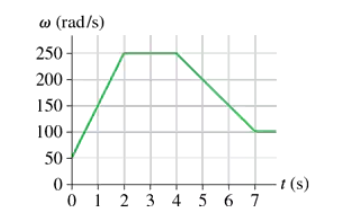
FIGURE EX4.36 shows the angular velocity graph of the crankshaft in a car. What is the crankshaft's angular acceleration at t = 3s

Guida verificata passo dopo passo
1
Identify the relevant section of the graph for t = 3s. From the graph, the angular velocity (ω) is constant at 200 rad/s between t = 2s and t = 4s.
Recall that angular acceleration (α) is defined as the rate of change of angular velocity with respect to time: α = dω/dt.
Since the angular velocity is constant in the interval from t = 2s to t = 4s, the slope of the graph (dω/dt) in this region is zero.
Conclude that the angular acceleration at t = 3s is zero because there is no change in angular velocity at this time.
Verify the interpretation by observing the flat (horizontal) segment of the graph between t = 2s and t = 4s, which confirms that the angular velocity does not change in this interval.

Risposta video verificata per un problema simile:

Questa soluzione video è stata consigliata dai nostri tutor come utile per risolvere questo problema.
Durata del video:
4m

Concetti chiave

Ecco i concetti essenziali che devi comprendere per rispondere correttamente alla domanda.

Angular Velocity

Angular velocity is a measure of how quickly an object rotates around an axis, expressed in radians per second (rad/s). In the context of the crankshaft, it indicates the speed of rotation at any given time, as shown in the graph. The slope of the angular velocity graph represents the angular acceleration, which is crucial for understanding how the rotation speed changes over time.
Video consigliato:
Percorso guidato
06:18
Intro to Angular Momentum

Angular Acceleration

Angular acceleration is the rate of change of angular velocity over time, typically measured in radians per second squared (rad/s²). It can be calculated by finding the slope of the angular velocity graph. At a specific time, such as t = 3s, the angular acceleration indicates how quickly the crankshaft's rotation speed is increasing or decreasing, which is essential for analyzing the performance of the engine.
Video consigliato:
Percorso guidato
12:12
Conservation of Angular Momentum

Graph Interpretation

Interpreting graphs is a fundamental skill in physics that involves analyzing the relationship between variables. In this case, the graph plots angular velocity against time, allowing us to visually assess changes in speed. By examining the graph's slope at specific points, we can determine angular acceleration, which is vital for understanding the dynamics of the crankshaft's motion.
Video consigliato:
Percorso guidato
07:32
Graphing Position, Velocity, and Acceleration Graphs
Pratica correlata
Domanda del libro di testo

Starting from rest, a DVD steadily accelerates to 500 rpm in 1.0 s, rotates at this angular speed for 3.0 s, then steadily decelerates to a halt in 2.0 s. How many revolutions does it make?

2078
views

Domanda del libro di testo

Your roommate is working on his bicycle and has the bike upside down. He spins the 60-cm-diameter wheel, and you notice that a pebble stuck in the tread goes by three times every second. What are the pebble's speed and acceleration?

2112
views
1
rank
Domanda del libro di testo

A speck of dust on a spinning DVD has a centripetal acceleration of 20 m/s3 . What would be the acceleration of the first speck of dust if the disk's angular velocity was doubled?

404
views
Domanda del libro di testo

The radius of the earth's very nearly circular orbit around the sun is 1.5 x 10¹¹ m. Find the magnitude of the earth's angular velocity.

2028
views
Domanda del libro di testo

A spaceship maneuvering near Planet Zeta is located at r=(600i−400j+200k)×103km,\(\mathbf{r}\) = (600\(\mathbf{i}\) - 400\(\mathbf{j}\) + 200\(\mathbf{k}\)) \(\times\) 10^3 \, \(\text{km}\), relative to the planet, and traveling at v=9500im/s\(\mathbf{v}\) = 9500\(\mathbf{i}\) \, \(\text{m/s}\). It turns on its thruster engine and accelerates with a=(40i−20k)m/s2\(\mathbf{a}\) = (40\(\mathbf{i}\) - 20\(\mathbf{k}\)) \, \(\text{m/s}\)^2 for 35 min35\(\text{ min}\). What is the spaceship's position when the engine shuts off? Give your answer as a position vector measured in km\(\operatorname{km}\).

2136
views
Domanda del libro di testo

A 5.0-m-diameter merry-go-round is initially turning with a 4.0 s period. It slows down and stops in 20 s. How many revolutions does the merry-go-round make as it stops?

2227
views