
Ch 04: Kinematics in Two Dimensions
Knight Calc - Physics for Scientists and Engineers 5th Edition
Knight Calc5th EditionPhysics for Scientists and EngineersISBN: 9780137344796Non è quello che usi tu?Cambia libro di testo
Capitolo 4, Problema 34b

A speck of dust on a spinning DVD has a centripetal acceleration of 20 m/s3 . What would be the acceleration of the first speck of dust if the disk's angular velocity was doubled?

Guida verificata passo dopo passo
1
Understand the relationship between centripetal acceleration and angular velocity. Centripetal acceleration (a_c) is given by the formula: ac=rω2, where r is the radius of the circular path and ω is the angular velocity.
Recognize that the centripetal acceleration is proportional to the square of the angular velocity. If the angular velocity is doubled, the centripetal acceleration will increase by a factor of 22, which is 4.
Set up the relationship between the initial centripetal acceleration and the new centripetal acceleration. Let the initial centripetal acceleration be ac=20 m/s2. The new centripetal acceleration will be 4×ac.
Substitute the given value of the initial centripetal acceleration into the equation for the new centripetal acceleration: ac,new=4×20.
Conclude that the new centripetal acceleration is four times the initial centripetal acceleration. Perform the multiplication to find the final value if needed.

Risposta video verificata per un problema simile:

Questa soluzione video è stata consigliata dai nostri tutor come utile per risolvere questo problema.

Concetti chiave

Ecco i concetti essenziali che devi comprendere per rispondere correttamente alla domanda.

Centripetal Acceleration

Centripetal acceleration is the acceleration directed towards the center of a circular path that keeps an object moving in that path. It is calculated using the formula a_c = v^2 / r, where v is the tangential velocity and r is the radius of the circular path. This acceleration is crucial for understanding how objects behave in circular motion.
Video consigliato:
Percorso guidato
06:48
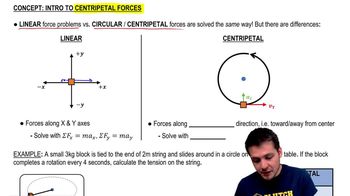
Intro to Centripetal Forces

Angular Velocity

Angular velocity is a measure of how quickly an object rotates around a central point, typically expressed in radians per second. When the angular velocity of a rotating object increases, the tangential velocity of points on the object also increases, which directly affects the centripetal acceleration experienced by those points.
Video consigliato:
Percorso guidato
06:18
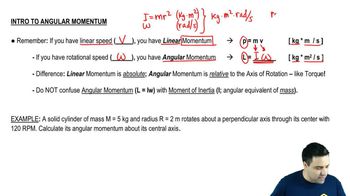
Intro to Angular Momentum

Relationship Between Angular Velocity and Centripetal Acceleration

The relationship between angular velocity and centripetal acceleration is defined by the equation a_c = r * ω^2, where ω is the angular velocity. If the angular velocity is doubled, the centripetal acceleration increases by a factor of four, since it is proportional to the square of the angular velocity. This concept is essential for predicting how changes in rotation affect acceleration.
Video consigliato:
Percorso guidato
03:43
Relationships Between Force, Field, Energy, Potential