Ch 04: Kinematics in Two Dimensions
Knight Calc - Physics for Scientists and Engineers 5th Edition
Knight Calc5th EditionPhysics for Scientists and EngineersISBN: 9780137344796Non è quello che usi tu?Cambia libro di testo
Capitolo 4, Problema 31

Peregrine falcons are known for their maneuvering ability. In a tight circular turn, a falcon can attain a centripetal acceleration 1.5 times the free-fall acceleration. What is the radius of the turn if the falcon is flying at 25 m/s?

Guida verificata passo dopo passo
1
Identify the given values: the centripetal acceleration is 1.5 times the free-fall acceleration, so \( a_c = 1.5g \), where \( g = 9.8 \ \text{m/s}^2 \). The velocity of the falcon is \( v = 25 \ \text{m/s} \). The goal is to find the radius of the turn \( r \).
Recall the formula for centripetal acceleration: \( a_c = \frac{v^2}{r} \), where \( a_c \) is the centripetal acceleration, \( v \) is the velocity, and \( r \) is the radius of the turn.
Substitute the expression for \( a_c \) into the formula: \( 1.5g = \frac{v^2}{r} \).
Rearrange the equation to solve for \( r \): \( r = \frac{v^2}{1.5g} \).
Substitute the known values of \( v = 25 \ \text{m/s} \) and \( g = 9.8 \ \text{m/s}^2 \) into the equation to calculate \( r \): \( r = \frac{(25)^2}{1.5 \times 9.8} \).

Risposta video verificata per un problema simile:

Questa soluzione video è stata consigliata dai nostri tutor come utile per risolvere questo problema.

Concetti chiave

Ecco i concetti essenziali che devi comprendere per rispondere correttamente alla domanda.

Centripetal Acceleration

Centripetal acceleration is the acceleration directed towards the center of a circular path that keeps an object moving in that path. It is calculated using the formula a_c = v^2 / r, where v is the tangential speed and r is the radius of the circular path. In this scenario, the falcon experiences a centripetal acceleration that is 1.5 times the acceleration due to gravity, which is approximately 9.81 m/s².
Video consigliato:
Percorso guidato
06:48
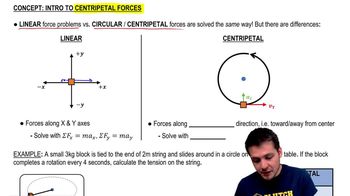
Intro to Centripetal Forces

Free-Fall Acceleration

Free-fall acceleration, often denoted as g, is the acceleration experienced by an object due solely to the force of gravity acting on it, typically measured as 9.81 m/s² on the surface of the Earth. This value is crucial for comparing other accelerations, such as the centripetal acceleration experienced by the falcon during its maneuver. Understanding this concept helps in determining the forces acting on the falcon during its flight.
Video consigliato:
Percorso guidato
08:36
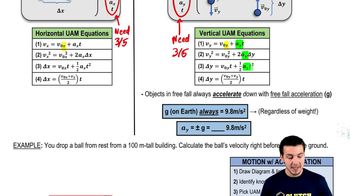
Vertical Motion & Free Fall

Circular Motion

Circular motion refers to the movement of an object along the circumference of a circle or a circular path. In this context, the falcon's flight involves uniform circular motion, where it maintains a constant speed while changing direction. The relationship between speed, radius, and centripetal acceleration is fundamental in analyzing the dynamics of circular motion, allowing us to calculate the radius of the turn based on the given speed and acceleration.
Video consigliato:
Percorso guidato
03:48
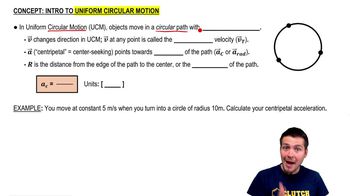
Intro to Circular Motion