
Ch 04: Kinematics in Two Dimensions
Knight Calc - Physics for Scientists and Engineers 5th Edition
Knight Calc5th EditionPhysics for Scientists and EngineersISBN: 9780137344796Non è quello che usi tu?Cambia libro di testo
Capitolo 4, Problema 61

While driving north at 25 m/s during a rainstorm you notice that the rain makes an angle of 38° with the vertical. While driving back home moments later at the same speed but in the opposite direction, you see that the rain is falling straight down. From these observations, determine the speed and angle of the raindrops relative to the ground.

Guida verificata passo dopo passo
1
Identify the reference frames: The car is moving north at 25 m/s in the first observation and south at 25 m/s in the second observation. The rain's motion relative to the car is observed in both cases, and we need to determine the rain's velocity relative to the ground.
Analyze the first observation: When driving north at 25 m/s, the rain appears to make an angle of 38° with the vertical. This means the horizontal component of the rain's velocity relative to the car is responsible for this angle. Use the relationship \( \tan(\theta) = \frac{v_{\text{horizontal}}}{v_{\text{vertical}}} \), where \( \theta = 38° \).
Set up the equations for the first observation: Let \( v_{\text{horizontal}} \) and \( v_{\text{vertical}} \) be the horizontal and vertical components of the rain's velocity relative to the ground. The horizontal velocity of the rain relative to the car is \( v_{\text{horizontal}} - 25 \), and \( \tan(38°) = \frac{v_{\text{horizontal}} - 25}{v_{\text{vertical}}} \).
Analyze the second observation: When driving south at 25 m/s, the rain appears to fall straight down. This means the horizontal velocity of the rain relative to the car is zero. Therefore, \( v_{\text{horizontal}} + 25 = 0 \), which gives \( v_{\text{horizontal}} = -25 \, \text{m/s} \).
Combine the results: Substitute \( v_{\text{horizontal}} = -25 \, \text{m/s} \) into the equation from the first observation to solve for \( v_{\text{vertical}} \). Then, use the Pythagorean theorem \( v_{\text{rain}} = \sqrt{v_{\text{horizontal}}^2 + v_{\text{vertical}}^2} \) to find the magnitude of the rain's velocity relative to the ground, and use \( \tan^{-1}(\frac{v_{\text{vertical}}}{|v_{\text{horizontal}}|}) \) to find the angle of the rain relative to the ground.

Risposta video verificata per un problema simile:

Questa soluzione video è stata consigliata dai nostri tutor come utile per risolvere questo problema.
Durata del video:
18m

Concetti chiave

Ecco i concetti essenziali che devi comprendere per rispondere correttamente alla domanda.

Relative Velocity

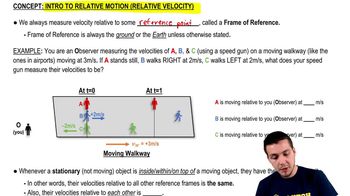
Relative velocity is the velocity of an object as observed from a particular reference frame. In this scenario, the speed of the car affects how the rain appears to fall. When the car moves north, the rain appears to come at an angle due to the combination of the car's velocity and the rain's velocity, which must be analyzed to find the actual speed and direction of the rain.
Video consigliato:
Percorso guidato
04:27
Intro to Relative Motion (Relative Velocity)

Vector Components

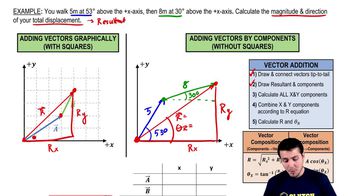
Vectors have both magnitude and direction, and they can be broken down into components along the axes of a coordinate system. In this problem, the rain's velocity can be decomposed into horizontal and vertical components. By analyzing these components when the car is moving in different directions, we can determine the actual velocity of the rain relative to the ground.
Video consigliato:
Percorso guidato
07:30
Vector Addition By Components

Trigonometric Relationships

Trigonometric functions relate the angles and sides of triangles, which are essential for solving problems involving angles and distances. In this case, the angle at which the rain falls can be analyzed using trigonometric ratios, such as sine and cosine, to find the vertical and horizontal components of the rain's velocity. This allows us to calculate the speed and direction of the rain relative to the ground.
Video consigliato:
Pratica correlata
Domanda del libro di testo

You're 6.0 m from one wall of the house seen in FIGURE P4.55. You want to toss a ball to your friend who is 6.0 m from the opposite wall. The throw and catch each occur 1.0 m above the ground. At what angle should you toss the ball?

2096
views
Domanda del libro di testo

A typical laboratory centrifuge rotates at 4000 rpm. Test tubes have to be placed into a centrifuge very carefully because of the very large accelerations. What is the acceleration at the end of a test tube that is 10 cm from the axis of rotation?

2110
views
1
rank
Domanda del libro di testo

The angular velocity of a spinning gyroscope is measured every 0.5 s. The results and the best-fit line from a spreadsheet are shown in FIGURE P4.63. What is the gyroscope's initial angular velocity at t = 0 s?

2287
views
Domanda del libro di testo

Ships A and B leave port together. For the next two hours, ship A travels at 20 mph in a direction 30° west of north while ship B travels 20° east of north at 25 mph. What is the speed of ship A as seen by ship B?

2073
views
Domanda del libro di testo

A cannonball is fired at 100 m/s from a barrel tilted upward at 25°. What is the angle after the cannonball travels 500 m?

2370
views
Domanda del libro di testo

A ball rolling on a circular track, starting from rest, has angular acceleration α\(\alpha\). Find an expression, in terms of α\(\alpha\), for the time at which the ball's acceleration vector a is 45∘45^{\(\circ\)} away from a radial line toward the center of the circle.

1812
views