Ch 05: Force and Motion
Knight Calc - Physics for Scientists and Engineers 5th Edition
Knight Calc5th EditionPhysics for Scientists and EngineersISBN: 9780137344796Non è quello che usi tu?Cambia libro di testo
Capitolo 5, Problema 10

For an object starting from rest and accelerating with constant acceleration, distance traveled is proportional to the square of the time. If an object travels 2.0 furlongs in the first 2.0 s, how far will it travel in the first 4.0 s?

Guida verificata passo dopo passo
1
Step 1: Begin by recalling the kinematic equation for distance traveled under constant acceleration: d = (1/2) a t2, where 'd' is the distance, 'a' is the constant acceleration, and 't' is the time.
Step 2: Since the object starts from rest, the initial velocity is zero, and the distance traveled is proportional to the square of the time. This means doubling the time will result in a distance that is four times greater.
Step 3: Use the given information to determine the acceleration. Plug in the values for the first interval: d = 2.0 furlongs and t = 2.0 seconds. Rearrange the formula to solve for 'a': a = (2d) / t2.
Step 4: Once the acceleration is determined, use the same kinematic equation to calculate the distance traveled in the first 4.0 seconds. Substitute t = 4.0 seconds into the formula: d = (1/2) a t2.
Step 5: Simplify the equation to find the distance traveled in the first 4.0 seconds. Remember that the distance will be proportional to the square of the time, so the result should be four times the distance traveled in the first 2.0 seconds.

Risposta video verificata per un problema simile:

Questa soluzione video è stata consigliata dai nostri tutor come utile per risolvere questo problema.
Durata del video:
10m

Concetti chiave

Ecco i concetti essenziali che devi comprendere per rispondere correttamente alla domanda.

Constant Acceleration

Constant acceleration refers to a situation where an object's velocity changes at a steady rate over time. In this context, it means that the object is accelerating uniformly, which allows us to use kinematic equations to predict its motion. This concept is crucial for understanding how distance, time, and acceleration relate to each other in linear motion.
Video consigliato:
Percorso guidato
08:59
Phase Constant of a Wave Function

Kinematic Equations

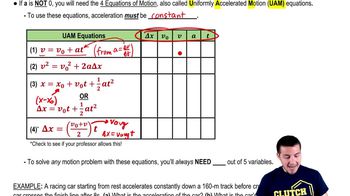
Kinematic equations describe the motion of objects under constant acceleration. One key equation states that the distance traveled (s) is equal to the initial velocity (u) multiplied by time (t) plus half the acceleration (a) multiplied by the square of time (t²). This relationship allows us to calculate distances and times for objects in motion, particularly when starting from rest.
Video consigliato:
Percorso guidato
08:25
Kinematics Equations

Proportionality in Motion

In the context of uniformly accelerated motion, the distance traveled is proportional to the square of the time elapsed. This means that if the time doubles, the distance traveled increases by a factor of four, assuming constant acceleration. Understanding this proportionality is essential for solving problems related to distance and time in physics.
Video consigliato: