
Ch 05: Force and Motion
Knight Calc - Physics for Scientists and Engineers 5th Edition
Knight Calc5th EditionPhysics for Scientists and EngineersISBN: 9780137344796Non è quello che usi tu?Cambia libro di testo
Capitolo 5, Problema 16b

What is the acceleration, as a multiple of g, if this force is applied to a 110 kg bicyclist? This is the combined mass of the cyclist and the bike.

Guida verificata passo dopo passo
1
Step 1: Begin by identifying the given values in the problem. The mass of the bicyclist and bike combined is 110 kg. The force applied is not explicitly stated in the problem, so ensure you have the value of the force from prior context or calculations.
Step 2: Recall Newton's Second Law of Motion, which states that \( F = ma \), where \( F \) is the force, \( m \) is the mass, and \( a \) is the acceleration. Rearrange this formula to solve for acceleration: \( a = \frac{F}{m} \).
Step 3: Substitute the given values into the formula. Use \( m = 110 \; \text{kg} \) and the force \( F \) (ensure you have the numerical value of \( F \) from the problem context). The acceleration \( a \) can now be calculated as \( a = \frac{F}{110} \).
Step 4: To express the acceleration as a multiple of \( g \) (where \( g \approx 9.8 \; \text{m/s}^2 \)), divide the calculated acceleration \( a \) by \( g \). This gives \( a_{\text{multiple}} = \frac{a}{g} = \frac{F}{110 \cdot g} \).
Step 5: Ensure the units are consistent throughout the calculation. The force \( F \) should be in newtons (\( \text{N} \)), the mass in kilograms (\( \text{kg} \)), and \( g \) in \( \text{m/s}^2 \). Once the formula is set up, you can calculate the numerical value if needed.

Risposta video verificata per un problema simile:

Questa soluzione video è stata consigliata dai nostri tutor come utile per risolvere questo problema.
Durata del video:
2m

Concetti chiave

Ecco i concetti essenziali che devi comprendere per rispondere correttamente alla domanda.

Newton's Second Law of Motion

Newton's Second Law states that the acceleration of an object is directly proportional to the net force acting on it and inversely proportional to its mass. This relationship is expressed by the formula F = ma, where F is the net force, m is the mass, and a is the acceleration. Understanding this law is crucial for calculating the acceleration of the bicyclist when a force is applied.
Video consigliato:
Percorso guidato
06:54
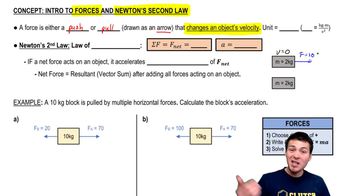
Intro to Forces & Newton's Second Law

Gravitational Acceleration (g)

Gravitational acceleration, denoted as g, is the acceleration due to Earth's gravity, approximately 9.81 m/s². When comparing other accelerations to g, we express them as multiples of this value. This concept is essential for understanding how the acceleration of the bicyclist relates to the force applied and how it compares to the force of gravity.
Video consigliato:
Percorso guidato
07:32
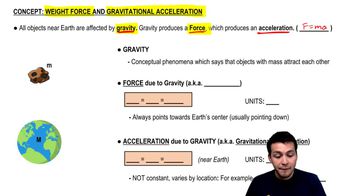
Weight Force & Gravitational Acceleration

Mass and Weight

Mass is a measure of the amount of matter in an object, typically measured in kilograms, while weight is the force exerted by gravity on that mass. The weight of the bicyclist and bike can be calculated using the formula W = mg, where W is weight, m is mass, and g is gravitational acceleration. Recognizing the distinction between mass and weight is important for applying Newton's Second Law correctly in this context.
Video consigliato:
Percorso guidato
10:19
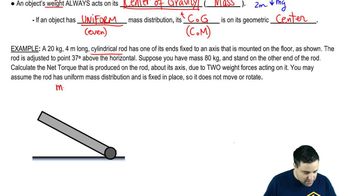
Torque Due to Weight