
Ch 06: Dynamics I: Motion Along a Line
Knight Calc - Physics for Scientists and Engineers 5th Edition
Knight Calc5th EditionPhysics for Scientists and EngineersISBN: 9780137344796Non è quello che usi tu?Cambia libro di testo
Capitolo 6, Problema 28

A 4000 kg truck is parked on a 15° slope. How big is the friction force on the truck? The coefficient of static friction between the tires and the road is 0.90.

Guida verificata passo dopo passo
1
Identify the forces acting on the truck: The truck is subject to gravitational force, normal force, and static friction. The gravitational force can be broken into two components: one parallel to the slope (causing the truck to slide down) and one perpendicular to the slope (contributing to the normal force).
Calculate the gravitational force acting on the truck using the formula: Fg = mg, where m is the mass of the truck (4000 kg) and g is the acceleration due to gravity (9.8 m/s²).
Determine the component of the gravitational force parallel to the slope using the formula: Fparallel = Fg sin(θ), where θ is the angle of the slope (15 degrees).
Calculate the maximum static friction force using the formula: Ffriction = μs Fnormal, where μs is the coefficient of static friction (0.90) and Fnormal is the normal force, calculated as Fg cos(θ).
Compare the parallel component of the gravitational force (Fparallel) with the maximum static friction force. If Fparallel is less than or equal to the maximum static friction force, the friction force equals Fparallel, as the truck does not slide.

Risposta video verificata per un problema simile:

Questa soluzione video è stata consigliata dai nostri tutor come utile per risolvere questo problema.
Durata del video:
6m

Concetti chiave

Ecco i concetti essenziali che devi comprendere per rispondere correttamente alla domanda.

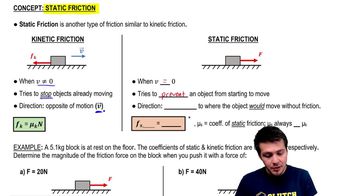
Static Friction

Static friction is the force that resists the initiation of sliding motion between two surfaces in contact. It acts parallel to the surfaces and is dependent on the normal force and the coefficient of static friction. The maximum static friction force can be calculated using the formula: F_friction = μ_s * N, where μ_s is the coefficient of static friction and N is the normal force.
Video consigliato:
Percorso guidato
08:11
Static Friction & Equilibrium

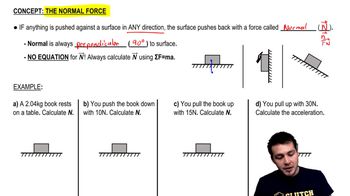
Normal Force

The normal force is the perpendicular force exerted by a surface to support the weight of an object resting on it. On an inclined plane, the normal force is less than the object's weight and can be calculated using the formula: N = mg * cos(θ), where m is the mass, g is the acceleration due to gravity, and θ is the angle of the incline. This force is crucial for determining the frictional force acting on the truck.
Video consigliato:
Percorso guidato
08:17
The Normal Force

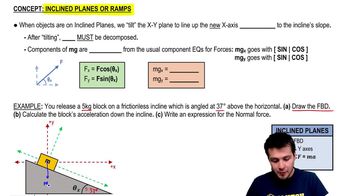
Inclined Plane

An inclined plane is a flat surface tilted at an angle to the horizontal, which affects the forces acting on an object resting on it. The angle of the incline influences both the normal force and the gravitational force components acting on the object. Understanding how to resolve these forces is essential for calculating the friction force and analyzing the object's stability on the slope.
Video consigliato:
Percorso guidato
06:59
Intro to Inclined Planes