Ch 06: Dynamics I: Motion Along a Line
Knight Calc - Physics for Scientists and Engineers 5th Edition
Knight Calc5th EditionPhysics for Scientists and EngineersISBN: 9780137344796Non è quello che usi tu?Cambia libro di testo
Capitolo 6, Problema 30

A 50,000 kg locomotive is traveling at 10 m/s when its engine and brakes both fail. How far will the locomotive roll before it comes to a stop? Assume the track is level.

Guida verificata passo dopo passo
1
Identify the given values: The mass of the locomotive \( m = 50,000 \, \text{kg} \), the initial velocity \( v_i = 10 \; \text{m/s} \), and the final velocity \( v_f = 0 \; \text{m/s} \). Since the engine and brakes fail, the stopping force is due to friction, but the coefficient of friction is not provided. Assume the deceleration is constant and use kinematic equations.
Write the kinematic equation that relates initial velocity, final velocity, acceleration, and displacement: \( v_f^2 = v_i^2 + 2a d \), where \( v_f \) is the final velocity, \( v_i \) is the initial velocity, \( a \) is the acceleration, and \( d \) is the displacement (distance traveled).
Rearrange the equation to solve for displacement \( d \): \( d = \frac{v_f^2 - v_i^2}{2a} \). Since \( v_f = 0 \), the equation simplifies to \( d = -\frac{v_i^2}{2a} \).
Determine the acceleration \( a \): The acceleration is caused by the frictional force, which can be expressed as \( F_f = \mu m g \), where \( \mu \) is the coefficient of friction and \( g \) is the acceleration due to gravity. The acceleration \( a \) is then \( a = -\mu g \). Substitute this into the displacement equation: \( d = \frac{v_i^2}{2 \mu g} \).
To find the distance \( d \), you need the coefficient of friction \( \mu \). If \( \mu \) is provided or assumed, substitute its value along with \( v_i = 10 \; \text{m/s} \) and \( g = 9.8 \; \text{m/s}^2 \) into the equation \( d = \frac{v_i^2}{2 \mu g} \) to calculate the distance.

Risposta video verificata per un problema simile:

Questa soluzione video è stata consigliata dai nostri tutor come utile per risolvere questo problema.
Durata del video:
6m

Concetti chiave

Ecco i concetti essenziali che devi comprendere per rispondere correttamente alla domanda.

Kinematics

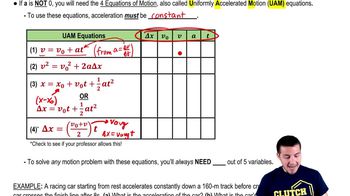
Kinematics is the branch of mechanics that deals with the motion of objects without considering the forces that cause the motion. It involves concepts such as displacement, velocity, and acceleration. In this scenario, we need to analyze the locomotive's motion as it decelerates to a stop, which can be described using kinematic equations.
Video consigliato:
Percorso guidato
08:25
Kinematics Equations

Friction

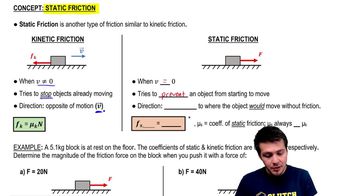
Friction is the force that opposes the relative motion of two surfaces in contact. In this case, the locomotive will experience kinetic friction between its wheels and the track, which will decelerate it until it comes to a stop. The coefficient of friction is crucial for calculating the distance traveled before stopping.
Video consigliato:
Percorso guidato
08:11
Static Friction & Equilibrium

Energy Conservation

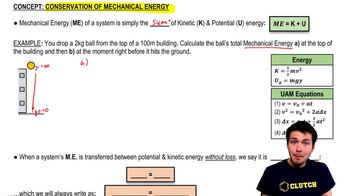
The principle of energy conservation states that energy cannot be created or destroyed, only transformed from one form to another. In this scenario, the locomotive's kinetic energy will be converted into thermal energy due to friction as it rolls to a stop. Understanding this concept helps in calculating the distance based on the initial kinetic energy and the work done by friction.
Video consigliato:
Percorso guidato
06:24
Conservation Of Mechanical Energy