
Ch 06: Dynamics I: Motion Along a Line
Knight Calc - Physics for Scientists and Engineers 5th Edition
Knight Calc5th EditionPhysics for Scientists and EngineersISBN: 9780137344796Non è quello che usi tu?Cambia libro di testo
Capitolo 6, Problema 6a

In an electricity experiment, a 1.0 g plastic ball is suspended on a 60-cm-long string and given an electric charge. A charged rod brought near the ball exerts a horizontal electrical force Felectric on it, causing the ball to swing out to a 20° angle and remain there. What is the magnitude of Felectric?

Guida verificata passo dopo passo
1
Step 1: Begin by analyzing the forces acting on the ball. The ball is in equilibrium, meaning the net force is zero. The forces acting on the ball are: (1) the tension in the string, (2) the gravitational force (F_gravity), and (3) the horizontal electrical force (F_electric).
Step 2: Break the tension force into its components. The tension force has two components: a vertical component (T_vertical) that balances the gravitational force, and a horizontal component (T_horizontal) that balances the electrical force. Use trigonometry to express these components: T_vertical = T * cos(θ) and T_horizontal = T * sin(θ), where θ = 20°.
Step 3: Relate the vertical component of the tension to the gravitational force. Since the ball is in equilibrium vertically, T_vertical = F_gravity. The gravitational force is given by F_gravity = m * g, where m = 1.0 g = 0.001 kg and g = 9.8 m/s².
Step 4: Use the relationship between T_horizontal and F_electric. Since the ball is in equilibrium horizontally, T_horizontal = F_electric. Substitute T_horizontal = T * sin(θ) into this equation.
Step 5: Combine the equations to solve for F_electric. First, find T using T_vertical = F_gravity = T * cos(θ). Then substitute T into T_horizontal = T * sin(θ) to find F_electric. The final expression for F_electric is F_electric = (m * g * sin(θ)) / cos(θ).

Risposta video verificata per un problema simile:

Questa soluzione video è stata consigliata dai nostri tutor come utile per risolvere questo problema.
Durata del video:
8m

Concetti chiave

Ecco i concetti essenziali che devi comprendere per rispondere correttamente alla domanda.

Electric Force

The electric force is the interaction between charged objects, described by Coulomb's law. It states that the force between two charges is directly proportional to the product of their charges and inversely proportional to the square of the distance between them. In this scenario, the charged rod exerts a horizontal electric force on the plastic ball, causing it to swing to a specific angle.
Video consigliato:
Percorso guidato
14:21
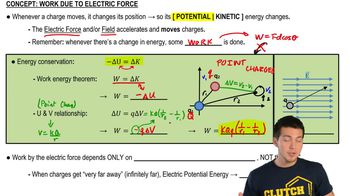
Work due to Electric Force

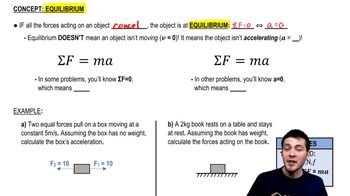
Equilibrium of Forces

In this experiment, the ball is in equilibrium, meaning the net force acting on it is zero. The forces acting on the ball include the gravitational force pulling it downward and the electric force acting horizontally. The tension in the string provides a vertical component that balances the weight of the ball and a horizontal component that balances the electric force, allowing the ball to remain at a constant angle.
Video consigliato:

Trigonometric Functions

Trigonometric functions, such as sine and cosine, are essential for analyzing the forces acting on the ball at the 20-degree angle. By resolving the tension in the string into its vertical and horizontal components, we can use these functions to relate the angle to the forces. This allows us to calculate the magnitude of the electric force by setting the horizontal component of tension equal to the electric force.
Video consigliato:
Percorso guidato
08:30
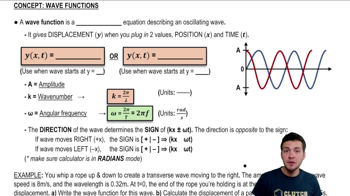
Intro to Wave Functions