
A football coach sits on a sled while two of his players build their strength by dragging the sled across the field with ropes. The friction force on the sled is 1000 N, the players have equal pulls, and the angle between the two ropes is 20°. How hard must each player pull to drag the coach at a steady 2.0 m/s?
Ch 06: Dynamics I: Motion Along a Line
Knight Calc5th EditionPhysics for Scientists and EngineersISBN: 9780137344796Non è quello che usi tu?Cambia libro di testo
Capitolo 6, Problema 1a
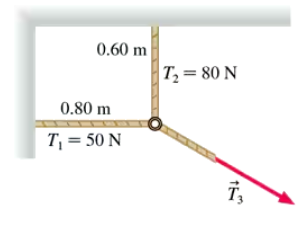
The three ropes in FIGURE EX6.1 are tied to a small, very light ring. Two of these ropes are anchored to walls at right angles with the tensions shown in the figure. What are the magnitude and direction of the tension T3 in the third rope?

Guida verificata passo dopo passo1
Identify the forces acting on the ring. The ring is in equilibrium, meaning the net force in both the horizontal (x) and vertical (y) directions must be zero. The forces are T1, T2, and T3, where T1 and T2 are given, and T3 is the unknown tension we need to find.
Resolve the forces T1 and T2 into their components. Since T1 and T2 are at right angles to each other, T1 contributes only to the horizontal direction (x-axis), and T2 contributes only to the vertical direction (y-axis). Write the components as: T1x = T1, T1y = 0, T2x = 0, T2y = T2.
Express the components of T3. Let T3 make an angle θ with the horizontal. Its components are: T3x = T3 * cos(θ) and T3y = T3 * sin(θ).
Apply the equilibrium conditions. For the x-direction: T1 - T3 * cos(θ) = 0. For the y-direction: T2 - T3 * sin(θ) = 0. These two equations will allow you to solve for T3 and θ.
Solve the system of equations. From the x-direction equation, solve for T3 * cos(θ) = T1. From the y-direction equation, solve for T3 * sin(θ) = T2. Use the Pythagorean identity (cos²(θ) + sin²(θ) = 1) to find T3, and then use trigonometric ratios to find θ.

Risposta video verificata per un problema simile:
Questa soluzione video è stata consigliata dai nostri tutor come utile per risolvere questo problema.
Concetti chiave
Ecco i concetti essenziali che devi comprendere per rispondere correttamente alla domanda.
Equilibrium of Forces
In physics, an object is in equilibrium when the net force acting on it is zero. This means that all the forces acting on the object balance each other out. In the context of the question, the ring is subjected to tensions from three ropes, and the equilibrium condition will help determine the unknown tension T3 by ensuring that the sum of the forces in both the horizontal and vertical directions equals zero.
Video consigliato:
Percorso guidato
Equilibrium
Vector Addition
Vector addition is the process of combining two or more vectors to determine a resultant vector. Each tension in the ropes can be represented as a vector with both magnitude and direction. To find the tension T3, one must consider the vectors of the known tensions and apply vector addition to solve for the unknown tension, ensuring that the resultant vector maintains the equilibrium condition.
Video consigliato:
Percorso guidato
Vector Addition By Components
Trigonometric Relationships
Trigonometric relationships are essential in resolving forces into their components, especially when dealing with angles. In this scenario, if the tensions are not aligned with the coordinate axes, trigonometric functions such as sine and cosine will be used to break down the tensions into their horizontal and vertical components. This breakdown is crucial for applying the equilibrium conditions effectively.
Video consigliato:
Percorso guidato
Trigonometry
Pratica correlata
Domanda del libro di testo
5397
views
3
rank
Domanda del libro di testo
In an electricity experiment, a 1.0 g plastic ball is suspended on a 60-cm-long string and given an electric charge. A charged rod brought near the ball exerts a horizontal electrical force Felectric on it, causing the ball to swing out to a 20° angle and remain there. What is the magnitude of Felectric?
2820
views
Domanda del libro di testo
The forces in FIGURE EX6.9 act on a 2.0 kg object. What are the values of ax and ay, the x- and y-components of the object's acceleration?
3195
views
