Ch 09: Work and Kinetic Energy
Knight Calc - Physics for Scientists and Engineers 5th Edition
Knight Calc5th EditionPhysics for Scientists and EngineersISBN: 9780137344796Non è quello che usi tu?Cambia libro di testo
Capitolo 9, Problema 41

A 70 kg human sprinter can accelerate from rest to 10 m/s in 3.0 s. During the same time interval, a 30 kg greyhound can go from rest to 20 m/s. What is the average power output of each? Average power over a time interval ∆t is ∆E/∆t.

Guida verificata passo dopo passo
1
Step 1: Start by recalling the formula for average power, which is given as \( P_{avg} = \frac{\Delta E}{\Delta t} \), where \( \Delta E \) is the change in energy and \( \Delta t \) is the time interval.
Step 2: The change in energy \( \Delta E \) is the change in kinetic energy, which can be calculated using the formula \( KE = \frac{1}{2} m v^2 \), where \( m \) is the mass and \( v \) is the velocity. For each case, calculate the final kinetic energy since the initial kinetic energy is zero (starting from rest).
Step 3: For the human sprinter, substitute \( m = 70 \ \text{kg} \) and \( v = 10 \ \text{m/s} \) into the kinetic energy formula: \( KE_{human} = \frac{1}{2} (70) (10)^2 \).
Step 4: For the greyhound, substitute \( m = 30 \ \text{kg} \) and \( v = 20 \ \text{m/s} \) into the kinetic energy formula: \( KE_{greyhound} = \frac{1}{2} (30) (20)^2 \).
Step 5: Divide the calculated kinetic energy for each case by the time interval \( \Delta t = 3.0 \ \text{s} \) to find the average power output: \( P_{avg, human} = \frac{KE_{human}}{3.0} \) and \( P_{avg, greyhound} = \frac{KE_{greyhound}}{3.0} \).

Risposta video verificata per un problema simile:

Questa soluzione video è stata consigliata dai nostri tutor come utile per risolvere questo problema.
Durata del video:
4m

Concetti chiave

Ecco i concetti essenziali che devi comprendere per rispondere correttamente alla domanda.

Kinetic Energy

Kinetic energy is the energy an object possesses due to its motion, calculated using the formula KE = 1/2 mv², where m is mass and v is velocity. In this scenario, both the sprinter and the greyhound are accelerating, which means their kinetic energy will change as they reach their final speeds. Understanding kinetic energy is essential for calculating the work done and the power output.
Video consigliato:
Percorso guidato
06:07
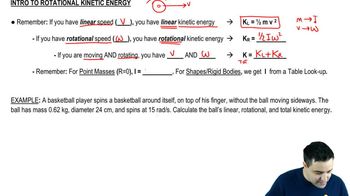
Intro to Rotational Kinetic Energy

Power

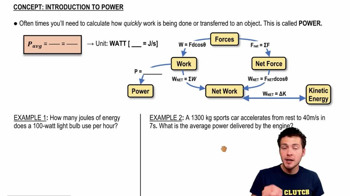
Power is defined as the rate at which work is done or energy is transferred over time, expressed mathematically as P = ∆E/∆t. In this context, average power output can be calculated by determining the change in kinetic energy for each athlete and dividing it by the time interval of their acceleration. This concept is crucial for comparing the performance of the sprinter and the greyhound.
Video consigliato:

Acceleration

Acceleration is the rate of change of velocity of an object over time, calculated as a = (v_f - v_i)/∆t, where v_f is final velocity, v_i is initial velocity, and ∆t is the time interval. Both the sprinter and the greyhound experience acceleration as they increase their speeds from rest. Understanding acceleration helps in determining the forces involved and the energy changes during their motion.
Video consigliato:
Percorso guidato
05:47
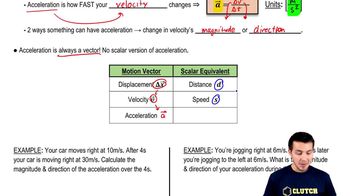
Intro to Acceleration