Ch 09: Work and Kinetic Energy
Knight Calc - Physics for Scientists and Engineers 5th Edition
Knight Calc5th EditionPhysics for Scientists and EngineersISBN: 9780137344796Non è quello che usi tu?Cambia libro di testo
Capitolo 9, Problema 37a

How much work does an elevator motor do to lift a 1000 kg elevator a height of 100 m?

Guida verificata passo dopo passo
1
Identify the formula for work done: Work (W) is given by the equation W=Fdcosθ, where F is the force, d is the displacement, and θ is the angle between the force and displacement vectors.
Determine the force required to lift the elevator: The force needed to lift the elevator is equal to its weight, which is calculated using F=mg, where m is the mass of the elevator (1000 kg) and g is the acceleration due to gravity (approximately 9.8 m/s²).
Substitute the values for force and displacement into the work formula: Since the force and displacement are in the same direction (upward), the angle θ is 0 degrees, and cos0 equals 1. The formula simplifies to W=mgd.
Plug in the known values: Substitute m=1000 kg, g=9.8 m/s², and d=100 m into the equation.
Simplify the expression to calculate the total work done: Perform the multiplication W=1000×9.8×100 to find the work done by the elevator motor.

Risposta video verificata per un problema simile:

Questa soluzione video è stata consigliata dai nostri tutor come utile per risolvere questo problema.
Durata del video:
5m

Concetti chiave

Ecco i concetti essenziali che devi comprendere per rispondere correttamente alla domanda.

Work

In physics, work is defined as the product of force and the distance over which that force is applied. It is calculated using the formula W = F × d, where W is work, F is the force applied, and d is the distance moved in the direction of the force. In the context of lifting an elevator, the force is equal to the weight of the elevator, which is the mass multiplied by the acceleration due to gravity.
Video consigliato:
Percorso guidato
06:58
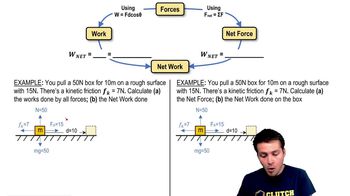
Calculating Net Work

Gravitational Force

Gravitational force is the attractive force between two masses, which on Earth is experienced as weight. It can be calculated using the formula F = m × g, where F is the gravitational force, m is the mass, and g is the acceleration due to gravity (approximately 9.81 m/s²). For the elevator, the gravitational force acting on it is crucial for determining the work done by the motor to lift it.
Video consigliato:
Percorso guidato
05:41
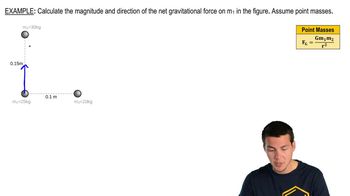
Gravitational Forces in 2D

Energy Conservation

The principle of energy conservation states that energy cannot be created or destroyed, only transformed from one form to another. In the case of the elevator, the electrical energy supplied to the motor is converted into mechanical energy to lift the elevator against the gravitational force. Understanding this principle helps in analyzing how much energy is required to perform the work of lifting the elevator.
Video consigliato:
Percorso guidato
06:24
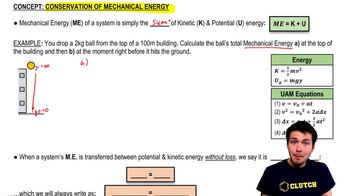
Conservation Of Mechanical Energy
Pratica correlata
Domanda del libro di testo

How much work must you do to push a 10 kg block of steel across a steel table at a steady speed of 1.0m/s for 3.0 s? What is your power output while doing so?

2219
views

Domanda del libro di testo

How much work does an elevator motor do to lift a 1000 kg elevator a height of 100 m? How much power must the motor supply to do this in 50 s at constant speed?

2167
views
Domanda del libro di testo

Justin, with a mass of 30 kg, is going down an 8.0-m-high water slide. He starts at rest, and his speed at the bottom is 11 m/s. How much thermal energy is created by friction during his descent?

2019
views
Domanda del libro di testo

An 8.0 kg crate is pulled 5.0 m up a 30° incline by a rope angled 18 ° above the incline. The tension in the rope is 120 N, and the crate's coefficient of kinetic friction on the incline is 0.25. What is the increase in thermal energy of the crate and incline?

3398
views
2
rank
Domanda del libro di testo

The energy used to pump liquids and gases through pipes is a significant fraction of the total energy consumption in the United States. Consider a small volume V of a liquid that has density ρ. Assume that the fluid is nonviscous so that friction with the pipe walls can be neglected. An upward-pushing force from a pump lifts this volume of fluid a height h at constant speed. How much work does the pump do?

2341
views
Domanda del libro di testo

A 70 kg human sprinter can accelerate from rest to 10 m/s in 3.0 s. During the same time interval, a 30 kg greyhound can go from rest to 20 m/s. What is the average power output of each? Average power over a time interval ∆t is ∆E/∆t.

2324
views