Ch 09: Work and Kinetic Energy
Knight Calc - Physics for Scientists and Engineers 5th Edition
Knight Calc5th EditionPhysics for Scientists and EngineersISBN: 9780137344796Non è quello che usi tu?Cambia libro di testo
Capitolo 9, Problema 20

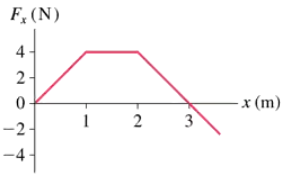
FIGURE EX9.20 is the force-versus-position graph for a particle moving along the x-axis. Determine the work done on the particle during each of the three intervals 0–1 m, 1–2 m, and 2–3 m.

Guida verificata passo dopo passo
1
Step 1: Understand the concept of work done. Work done (W) is calculated as the area under the force (F) versus position (x) graph. For each interval, calculate the area under the graph corresponding to that interval.
Step 2: Convert the x-axis units from cm to m, as the problem specifies intervals in meters. For example, 0–1 m corresponds to 0–100 cm, 1–2 m corresponds to 100–200 cm, and 2–3 m corresponds to 200–300 cm.
Step 3: For the interval 0–1 m (0–100 cm), observe that the force is constant at 2 N. The area under the graph is a rectangle with width 1 m and height 2 N. Use the formula for the area of a rectangle: \( \text{Area} = \text{Force} \times \text{Displacement} \).
Step 4: For the interval 1–2 m (100–200 cm), observe that the force increases linearly from 2 N to 6 N. The area under the graph is a trapezoid. Use the formula for the area of a trapezoid: \( \text{Area} = \frac{1}{2} \times (\text{Base}_1 + \text{Base}_2) \times \text{Height} \), where the bases are the force values and the height is the displacement.
Step 5: For the interval 2–3 m (200–300 cm), observe that the force decreases linearly from 6 N to 0 N. The area under the graph is a triangle. Use the formula for the area of a triangle: \( \text{Area} = \frac{1}{2} \times \text{Base} \times \text{Height} \), where the base is the displacement and the height is the force.

Risposta video verificata per un problema simile:

Questa soluzione video è stata consigliata dai nostri tutor come utile per risolvere questo problema.
Durata del video:
9m

Concetti chiave

Ecco i concetti essenziali che devi comprendere per rispondere correttamente alla domanda.

Work Done by a Force

Work is defined as the product of the force applied to an object and the distance over which that force is applied, specifically in the direction of the force. Mathematically, it is expressed as W = F × d × cos(θ), where θ is the angle between the force and the direction of motion. In the context of a force-versus-position graph, the work done can be calculated as the area under the curve of the graph for the specified intervals.
Video consigliato:
Percorso guidato
06:09
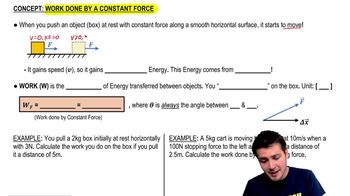
Work Done by a Constant Force

Area Under the Force-Position Graph

The area under a force versus position graph represents the work done on the particle as it moves through a given distance. For linear segments, this area can be calculated using geometric shapes such as rectangles and triangles. The total work done over an interval can be found by summing the areas of these shapes, which correspond to the force applied over the distance traveled.
Video consigliato:
Percorso guidato
04:05
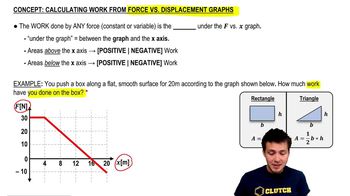
Calculating Work As Area Under F-x Graphs

Intervals of Motion

In this problem, the motion of the particle is divided into three distinct intervals: 0–1 m, 1–2 m, and 2–3 m. Each interval may have different forces acting on the particle, which affects the work done in each segment. Understanding the behavior of the force in each interval is crucial for accurately calculating the total work done, as the force may vary in magnitude and direction across these segments.
Video consigliato:
Percorso guidato
07:29
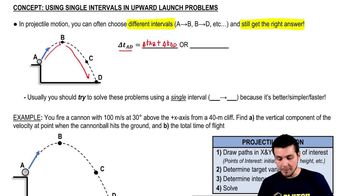
Using Single Intervals in Positive Launch Problems
Pratica correlata
Domanda del libro di testo

The three ropes shown in the bird's-eye view of FIGURE EX9.18 are used to drag a crate 3.0 m across the floor. How much work is done by each of the three forces?

2628
views

Domanda del libro di testo

A particle moving on the x-axis experiences a force given by Fx = qx², where q is a constant. How much work is done on the particle as it moves from x = 0 to x = d?

2537
views
1
rank
Domanda del libro di testo

A 25 kg air compressor is dragged up a rough incline from r⃗1=(1.3ı^+1.3ȷ^)m\(\vec{r}\)_1 = (1.3\(\hat{\imath}\) + 1.3\(\hat{\jmath}\)) \, \(\text{m}\) to r⃗2=(8.3ı^+2.9ȷ^)m\(\vec{r}\)_2 = (8.3\(\hat{\imath}\) + 2.9\(\hat{\jmath}\)) \, \(\text{m}\), to where the y-axis is vertical. How much work does gravity do on the compressor during this displacement?

1923
views
Domanda del libro di testo

A 45 g bug is hovering in the air. A gust of wind exerts a force F⃗=(4.0ı^−6.0ȷ^)×10−2N\(\vec{F}\) = (4.0\(\hat{\imath}\) - 6.0\(\hat{\jmath}\)) \(\times\) 10^{-2} \, \(\text{N}\) on the bug. What is the bug's speed at the end of this displacement? Assume that the speed is due entirely to the wind.

2164
views
Domanda del libro di testo

A 35-cm-long vertical spring has one end fixed on the floor. Placing a 2.2 kg physics textbook on the spring compresses it to a length of 29 cm. What is the spring constant?

1229
views
Domanda del libro di testo

A 2.0 kg particle moving along the x-axis experiences the force shown in FIGURE EX9.22. The particle's velocity is 3.0 m/s at x = 0 m. At what point on the x-axis does the particle have a turning point?

4027
views