Ch 09: Work and Kinetic Energy
Knight Calc - Physics for Scientists and Engineers 5th Edition
Knight Calc5th EditionPhysics for Scientists and EngineersISBN: 9780137344796Non è quello che usi tu?Cambia libro di testo
Capitolo 9, Problema 16b

A 45 g bug is hovering in the air. A gust of wind exerts a force F⃗=(4.0ı^−6.0ȷ^)×10−2N\(\vec{F}\) = (4.0\(\hat{\imath}\) - 6.0\(\hat{\jmath}\)) \(\times\) 10^{-2} \, \(\text{N}\) on the bug. What is the bug's speed at the end of this displacement? Assume that the speed is due entirely to the wind.

Guida verificata passo dopo passo
1
Convert the mass of the bug from grams to kilograms, as SI units require mass in kilograms. Use the conversion: 1 g = 0.001 kg. Thus, the mass of the bug is m = 45 g × 0.001 kg/g.
Determine the acceleration of the bug using Newton's second law: F = ma. Rearrange to find acceleration: a = F/m. The force vector is given as F = (4.0\(\text{i}\) - 6.0\(\text{j}\)) × 10^{-2} N, and the mass is m (calculated in step 1). Perform vector division to find the acceleration components.
Calculate the magnitude of the acceleration vector using the formula: |a| = \(\text{sqrt}\)(a_x^2 + a_y^2), where a_x and a_y are the components of the acceleration vector found in step 2.
Use the kinematic equation to find the final speed of the bug: v = a imes t, where a is the magnitude of the acceleration (from step 3) and t is the time of displacement. If the time is not provided, it must be assumed or given in the problem context.
Combine the results to express the final speed of the bug. Ensure that the speed is due entirely to the wind, as stated in the problem, and verify that all units are consistent (meters per second for speed).

Risposta video verificata per un problema simile:

Questa soluzione video è stata consigliata dai nostri tutor come utile per risolvere questo problema.
Durata del video:
6m

Concetti chiave

Ecco i concetti essenziali che devi comprendere per rispondere correttamente alla domanda.

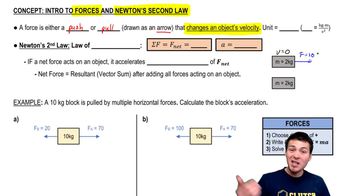
Newton's Second Law of Motion

Newton's Second Law states that the acceleration of an object is directly proportional to the net force acting on it and inversely proportional to its mass. This relationship is expressed by the equation F = ma, where F is the net force, m is the mass, and a is the acceleration. In this scenario, the force exerted by the wind will cause the bug to accelerate, which is essential for determining its final speed.
Video consigliato:
Percorso guidato
06:54
Intro to Forces & Newton's Second Law

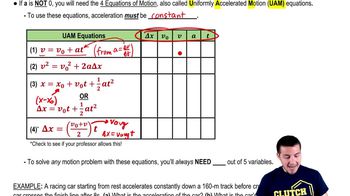
Kinematics

Kinematics is the branch of mechanics that deals with the motion of objects without considering the forces that cause the motion. It involves concepts such as displacement, velocity, and acceleration. To find the bug's speed at the end of the displacement, we can use kinematic equations that relate these quantities, particularly when the initial speed is zero.
Video consigliato:
Percorso guidato
08:25
Kinematics Equations

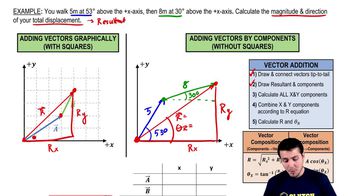
Vector Addition

Vector addition is the process of combining two or more vectors to determine a resultant vector. In this problem, the force exerted by the wind is given as a vector, and understanding how to add vectors is crucial for analyzing the bug's motion. The components of the force vector will influence the bug's acceleration in both the x and y directions, affecting its overall speed.
Video consigliato:
Percorso guidato
07:30
Vector Addition By Components