You throw a 5.5 g coin straight down at 4.0 m/s from a 35-m-high bridge. What is the speed of the coin just as it hits the water?
Ch 09: Work and Kinetic Energy
Knight Calc5th EditionPhysics for Scientists and EngineersISBN: 9780137344796Non è quello che usi tu?Cambia libro di testo
Capitolo 9, Problema 9a
The cable of a crane is lifting a 750 kg girder. The girder increases its speed from 0.25 m/s to 0.75 m/s in a distance of 3.5 m. How much work is done by gravity?
Guida verificata passo dopo passo1
Step 1: Recall the formula for work done by gravity, which is given by \( W = F \cdot d \cdot \cos(\theta) \), where \( F \) is the gravitational force, \( d \) is the displacement, and \( \theta \) is the angle between the force and displacement vectors.
Step 2: Calculate the gravitational force \( F \) acting on the girder. The gravitational force is given by \( F = m \cdot g \), where \( m \) is the mass of the girder (750 kg) and \( g \) is the acceleration due to gravity (approximately \( 9.8 \, \text{m/s}^2 \)).
Step 3: Determine the angle \( \theta \) between the gravitational force and the displacement. Since the girder is being lifted vertically, the gravitational force acts downward, while the displacement is upward. Thus, \( \theta = 180^\circ \), and \( \cos(180^\circ) = -1 \).
Step 4: Substitute the values into the work formula. Using \( F = m \cdot g \), \( d = 3.5 \, \text{m} \), and \( \cos(\theta) = -1 \), the work done by gravity is \( W = (750 \cdot 9.8) \cdot 3.5 \cdot (-1) \).
Step 5: Simplify the expression to find the work done by gravity. Note that the negative sign indicates that gravity does work in the direction opposite to the displacement.

Risposta video verificata per un problema simile:
Questa soluzione video è stata consigliata dai nostri tutor come utile per risolvere questo problema.
Durata del video:
5mConcetti chiave
Ecco i concetti essenziali che devi comprendere per rispondere correttamente alla domanda.
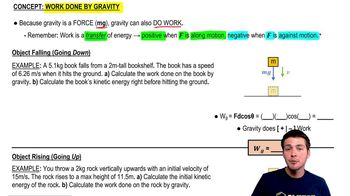
Work Done by Gravity
Work done by gravity is calculated using the formula W = mgh, where W is the work, m is the mass, g is the acceleration due to gravity (approximately 9.81 m/s²), and h is the height through which the object moves. In this context, the work done by gravity will be negative if the object is moving upward, as gravity opposes the motion.
Video consigliato:
Percorso guidato
Work Done By Gravity
Kinetic Energy
Kinetic energy (KE) is the energy an object possesses due to its motion, given by the formula KE = 0.5mv², where m is the mass and v is the velocity. Understanding kinetic energy is essential for analyzing the changes in energy as the girder accelerates from 0.25 m/s to 0.75 m/s, which will help in determining the net work done on the girder.
Video consigliato:
Percorso guidato
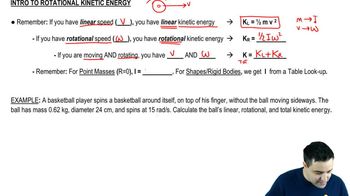
Intro to Rotational Kinetic Energy
Conservation of Energy
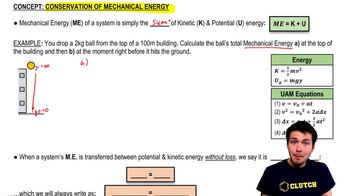
The principle of conservation of energy states that energy cannot be created or destroyed, only transformed from one form to another. In this scenario, the work done by the crane must equal the change in kinetic energy of the girder plus the work done against gravity, allowing for a comprehensive analysis of the forces and energy involved in lifting the girder.
Video consigliato:
Percorso guidato
Conservation Of Mechanical Energy
Pratica correlata
Domanda del libro di testo
1835
views
Domanda del libro di testo
At what speed does a 1000 kg compact car have the same kinetic energy as a 20,000 kg truck going 25 km/h?
2319
views
Domanda del libro di testo
A 25 kg air compressor is dragged up a rough incline from to , to where the y-axis is vertical. How much work does gravity do on the compressor during this displacement?
1923
views
Domanda del libro di testo
A pitcher accelerates a 150 g baseball from rest to 35 m/s. How much work does the pitcher do on the ball?
2737
views
Domanda del libro di testo
A mother has four times the mass of her young son. Both are running with the same kinetic energy. What is the ratio vson/vmother of their speeds?
2347
views
Domanda del libro di testo
A 45 g bug is hovering in the air. A gust of wind exerts a force on the bug. What is the bug's speed at the end of this displacement? Assume that the speed is due entirely to the wind.
2164
views