
Ch 10: Interactions and Potential Energy
Knight Calc - Physics for Scientists and Engineers 5th Edition
Knight Calc5th EditionPhysics for Scientists and EngineersISBN: 9780137344796Non è quello che usi tu?Cambia libro di testo
Capitolo 10, Problema 40

A cable with 20.0 N of tension pulls straight up on a 1.50 kg block that is initially at rest. What is the block's speed after being lifted 2.00 m? Solve this problem using work and energy.

Guida verificata passo dopo passo
1
Step 1: Identify the forces acting on the block. The upward force is the tension in the cable (20.0 N), and the downward force is the gravitational force, which can be calculated as \( F_g = m \cdot g \), where \( m = 1.50 \; \text{kg} \) and \( g = 9.8 \; \text{m/s}^2 \).
Step 2: Determine the net force acting on the block. The net force is given by \( F_{\text{net}} = F_T - F_g \), where \( F_T \) is the tension in the cable and \( F_g \) is the gravitational force.
Step 3: Calculate the work done by the net force. Work is defined as \( W = F_{\text{net}} \cdot d \), where \( d = 2.00 \; \text{m} \) is the distance the block is lifted. Ensure that the direction of the net force and displacement are aligned.
Step 4: Relate the work done to the change in kinetic energy using the work-energy theorem, \( W = \Delta KE \). Since the block starts from rest, \( \Delta KE = \frac{1}{2} m v^2 \), where \( v \) is the final speed of the block.
Step 5: Solve for the final speed \( v \) by rearranging the equation \( W = \frac{1}{2} m v^2 \) to \( v = \sqrt{\frac{2W}{m}} \). Substitute the values of \( W \) and \( m \) to find the final speed.

Risposta video verificata per un problema simile:

Questa soluzione video è stata consigliata dai nostri tutor come utile per risolvere questo problema.
Durata del video:
7m

Concetti chiave

Ecco i concetti essenziali che devi comprendere per rispondere correttamente alla domanda.

Work-Energy Principle

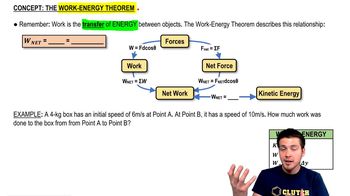
The Work-Energy Principle states that the work done on an object is equal to the change in its kinetic energy. In this context, the work done by the tension in the cable on the block will increase its kinetic energy as it is lifted. This principle allows us to relate the force applied, the distance moved, and the resulting speed of the block.
Video consigliato:
Percorso guidato
04:10
The Work-Energy Theorem

Gravitational Potential Energy

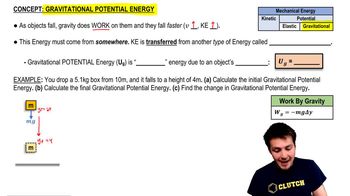
Gravitational potential energy (PE) is the energy an object possesses due to its position in a gravitational field. It is calculated using the formula PE = mgh, where m is mass, g is the acceleration due to gravity, and h is the height. As the block is lifted, its potential energy increases, which must be accounted for when calculating the total energy changes in the system.
Video consigliato:
Percorso guidato
06:35
Gravitational Potential Energy

Kinetic Energy

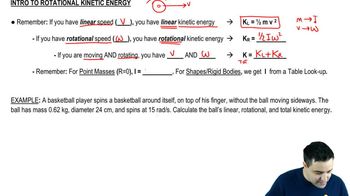
Kinetic energy (KE) is the energy of an object due to its motion, given by the formula KE = 0.5mv², where m is mass and v is velocity. In this problem, as the block is lifted and work is done on it, its kinetic energy will increase, allowing us to determine its speed after being lifted a certain distance by equating the work done to the change in kinetic energy.
Video consigliato:
Percorso guidato
06:07
Intro to Rotational Kinetic Energy
Pratica correlata
Domanda del libro di testo

You have been hired to design a spring-launched roller coaster that will carry two passengers per car. The car goes up a 10-m-high hill, then descends 15 m to the track's lowest point. You've determined that the spring can be compressed a maximum of 2.0 m and that a loaded car will have a maximum mass of 400 kg. For safety reasons, the spring constant should be 10% larger than the minimum needed for the car to just make it over the top. What is the maximum speed of a 350 kg car if the spring is compressed the full amount?

1993
views
Domanda del libro di testo

A particle moves from A to D in FIGURE EX10.36 while experiencing force F = (6i + 8j) N. How much work does the force do if the particle follows path ACD. Is this a conservative force? Explain.

2197
views
Domanda del libro di testo

A particle moving along the x-axis is in a system that has potential energy U = x3 - 3x J, where x is in m. For each, is it a point of stable or unstable equilibrium?

841
views
Domanda del libro di testo

A 50 g mass is attached to a light, rigid, 75-cm-long rod. The other end of the rod is pivoted so that the mass can rotate in a vertical circle. What speed does the mass need at the bottom of the circle to barely make it over the top of the circle?

1978
views
Domanda del libro di testo

How much work is done by the environment in the process shown in FIGURE EX10.39? Is energy transferred from the environment to the system or from the system to the environment?

1673
views
Domanda del libro di testo

A 50 g ice cube can slide up and down a frictionless 30° slope. At the bottom, a spring with spring constant 25 N/m is compressed 10 cm and used to launch the ice cube up the slope. How high does it go above its starting point?

1621
views