Ch 10: Interactions and Potential Energy
Knight Calc - Physics for Scientists and Engineers 5th Edition
Knight Calc5th EditionPhysics for Scientists and EngineersISBN: 9780137344796Non è quello che usi tu?Cambia libro di testo
Capitolo 10, Problema 36b

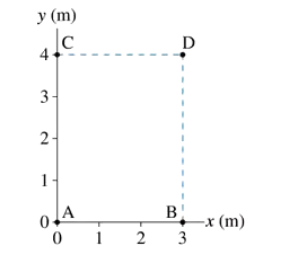
A particle moves from A to D in FIGURE EX10.36 while experiencing force F = (6i + 8j) N. How much work does the force do if the particle follows path ACD. Is this a conservative force? Explain.

Guida verificata passo dopo passo
1
Step 1: Understand the problem. The particle moves along path ACD under the influence of a force F = (6i + 8j) N. The goal is to calculate the work done by the force along this path and determine if the force is conservative.
Step 2: Recall the formula for work done by a force: W = ∫ F · dr, where F is the force vector and dr is the displacement vector. For a conservative force, the work done depends only on the initial and final positions, not the path taken.
Step 3: Break the path ACD into segments AC and CD. For segment AC, calculate the displacement vector by subtracting the coordinates of A from C. For segment CD, calculate the displacement vector by subtracting the coordinates of C from D.
Step 4: Compute the dot product F · dr for each segment. For segment AC, use the displacement vector of AC and the force vector F. Similarly, for segment CD, use the displacement vector of CD and the force vector F.
Step 5: Add the work done along each segment to find the total work done along path ACD. To determine if the force is conservative, check if the work done is the same for all paths between the same initial and final points.

Risposta video verificata per un problema simile:

Questa soluzione video è stata consigliata dai nostri tutor come utile per risolvere questo problema.
Durata del video:
10m

Concetti chiave

Ecco i concetti essenziali che devi comprendere per rispondere correttamente alla domanda.

Work Done by a Force

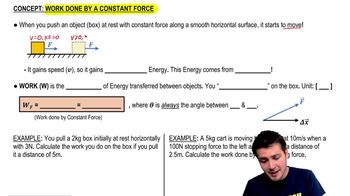
Work is defined as the product of the force applied to an object and the displacement of that object in the direction of the force. Mathematically, it is expressed as W = F · d, where W is work, F is the force vector, and d is the displacement vector. In this case, the work done by the force F as the particle moves along the path ACD can be calculated by integrating the force along the specified path.
Video consigliato:
Percorso guidato
06:09
Work Done by a Constant Force

Path Dependence of Work

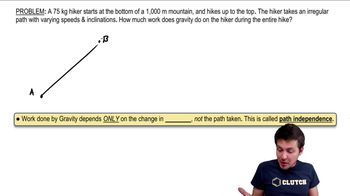
The work done by a force can depend on the path taken by the object when moving from one point to another. For non-conservative forces, the work done can vary based on the specific trajectory. In contrast, conservative forces, such as gravitational force, yield the same work regardless of the path taken, depending only on the initial and final positions.
Video consigliato:
Percorso guidato
02:30
Work Done on Curvy (Not straight) Paths

Conservative Forces

A force is considered conservative if the work done by the force on an object moving between two points is independent of the path taken. Examples include gravitational and electrostatic forces. To determine if the force F in the question is conservative, one can check if the work done along different paths (like ACD and others) yields the same result, or if the force can be derived from a potential energy function.
Video consigliato:
Percorso guidato
06:43
Energy Conservation with Non-Conservative Forces