
Ch 11: Impulse and Momentum
Knight Calc - Physics for Scientists and Engineers 5th Edition
Knight Calc5th EditionPhysics for Scientists and EngineersISBN: 9780137344796Non è quello che usi tu?Cambia libro di testo
Capitolo 11, Problema 31

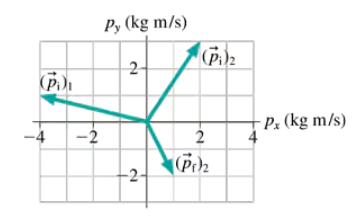
Two objects collide and bounce apart. FIGURE EX11.31 shows the initial momenta of both and the final momentum of object 2. What is the final momentum of object 1? Write your answer using unit vectors.

Guida verificata passo dopo passo
1
Step 1: Identify the given information from the graph. The initial momentum of object A (pA,i) and object B (pB,i) are shown as vectors, along with the final momentum of object B (pB,f). The task is to find the final momentum of object A (pA,f).
Step 2: Apply the principle of conservation of momentum. The total momentum before the collision must equal the total momentum after the collision. Mathematically, this is expressed as: pA,i + pB,i = pA,f + pB,f.
Step 3: Break the momentum vectors into their x and y components. From the graph: pA,i = (2, 2), pB,i = (-1, 1), and pB,f = (1, 1). Use these values to calculate the components of pA,f.
Step 4: Solve for the x-component of pA,f. Using conservation of momentum in the x-direction: pA,i,x + pB,i,x = pA,f,x + pB,f,x. Substitute the values: 2 + (-1) = pA,f,x + 1. Solve for pA,f,x.
Step 5: Solve for the y-component of pA,f. Using conservation of momentum in the y-direction: pA,i,y + pB,i,y = pA,f,y + pB,f,y. Substitute the values: 2 + 1 = pA,f,y + 1. Solve for pA,f,y.

Risposta video verificata per un problema simile:

Questa soluzione video è stata consigliata dai nostri tutor come utile per risolvere questo problema.
Durata del video:
8m

Concetti chiave

Ecco i concetti essenziali che devi comprendere per rispondere correttamente alla domanda.

Momentum

Momentum is a vector quantity defined as the product of an object's mass and its velocity. It is represented as p = mv, where p is momentum, m is mass, and v is velocity. In collisions, momentum is conserved, meaning the total momentum before the collision equals the total momentum after the collision, provided no external forces act on the system.
Video consigliato:
Percorso guidato
05:17
Intro to Momentum

Vector Addition

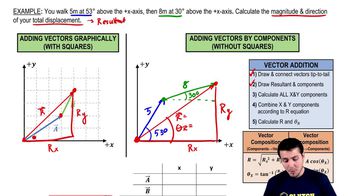
Vector addition is the process of combining two or more vectors to determine a resultant vector. In the context of momentum, this involves adding the momentum vectors of the colliding objects. The components of the vectors are added separately in the x and y directions, allowing for the calculation of the final momentum of each object after the collision.
Video consigliato:
Percorso guidato
07:30
Vector Addition By Components

Elastic Collision

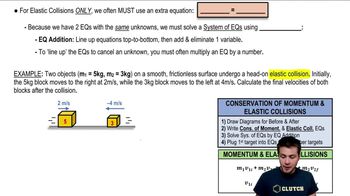
An elastic collision is a type of collision where both momentum and kinetic energy are conserved. In such collisions, the objects bounce off each other without any loss of kinetic energy. This is in contrast to inelastic collisions, where kinetic energy is not conserved. Understanding the nature of the collision is crucial for applying the conservation laws correctly to find the final momenta of the objects involved.
Video consigliato:
Percorso guidato
08:56
Intro To Elastic Collisions
Pratica correlata
Domanda del libro di testo

A 70.00 kg football player is gliding across very smooth ice at 2.00 m/s. He throws a 0.450 kg football straight forward. What is the player's speed afterward if the ball is thrown at 15.0 m/s relative to the ground?

2289
views
Domanda del libro di testo

A 50 g ball of clay traveling at speed v0 hits and sticks to a 1.0 kg brick sitting at rest on a frictionless surface. What is the speed of the brick after the collision?

1762
views
Domanda del libro di testo

Dan is gliding on his skateboard at 4.0 m/s. He suddenly jumps backward off the skateboard, kicking the skateboard forward at 8.0 m/s. How fast is Dan going as his feet hit the ground? Dan's mass is 50 kg and the skateboard's mass is 5.0 kg.

1940
views
Domanda del libro di testo

An object at rest explodes into three fragments. FIGURE EX11.32 shows the momentum vectors of two of the fragments. What is the momentum of the third fragment? Write your answer using unit vectors.

2472
views
Domanda del libro di testo

A 20 g ball of clay traveling east at 3.0 m/s collides with a 30 g ball of clay traveling north at 2.0 m/s. What are the speed and the direction of the resulting 50 g ball of clay? Give your answer as an angle north of east.

2005
views
Domanda del libro di testo

At the center of a 50-m-diameter circular ice rink, a 75 kg skater traveling north at 2.5 m/s collides with and holds on to a 60 kg skater who had been heading west at 3.5 m/s. Where will they reach it? Give your answer as an angle north of west.

1785
views