Ch 12: Rotation of a Rigid Body
Knight Calc - Physics for Scientists and Engineers 5th Edition
Knight Calc5th EditionPhysics for Scientists and EngineersISBN: 9780137344796Non è quello che usi tu?Cambia libro di testo
Capitolo 12, Problema 26

A 1.0 kg ball and a 2.0 kg ball are connected by a 1.0-m-long rigid, massless rod. The rod is rotating cw about its center of mass at 20 rpm. What net torque will bring the balls to a halt in 5.0 s?

Guida verificata passo dopo passo
1
Step 1: Calculate the center of mass of the system. Since the rod is massless, the center of mass depends only on the masses of the balls. Use the formula for the center of mass: x=m1x1+m2x2m1+m2, where x1 and x2 are the positions of the masses relative to one end of the rod.
Step 2: Determine the moment of inertia of the system about the center of mass. Use the formula for the moment of inertia: I=m1r1+m2r2, where r1 and r2 are the distances of the masses from the center of mass.
Step 3: Convert the angular velocity from rpm to rad/s. Use the conversion factor: (1 rpm)=2π60 rad/s. Multiply the given angular velocity (20 rpm) by this factor to find the angular velocity in rad/s.
Step 4: Calculate the angular deceleration required to bring the system to a halt in 5.0 s. Use the kinematic equation: α=ω-0t, where ω is the initial angular velocity, and t is the time.
Step 5: Calculate the net torque required to achieve this angular deceleration. Use the rotational analog of Newton's second law: τ=Iα, where I is the moment of inertia and α is the angular deceleration.

Risposta video verificata per un problema simile:

Questa soluzione video è stata consigliata dai nostri tutor come utile per risolvere questo problema.
Durata del video:
14m

Concetti chiave

Ecco i concetti essenziali che devi comprendere per rispondere correttamente alla domanda.

Torque

Torque is a measure of the rotational force applied to an object, calculated as the product of the force and the distance from the pivot point (lever arm). It determines how effectively a force can cause an object to rotate about an axis. In this scenario, understanding torque is essential to calculate the net torque required to stop the rotating system.
Video consigliato:
Percorso guidato
08:55
Net Torque & Sign of Torque

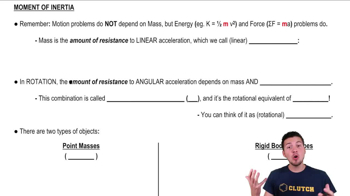
Moment of Inertia

Moment of inertia quantifies an object's resistance to changes in its rotational motion, depending on the mass distribution relative to the axis of rotation. For the two balls connected by a rod, the moment of inertia can be calculated by considering the masses of the balls and their distances from the center of mass. This concept is crucial for determining how much torque is needed to bring the system to a halt.
Video consigliato:
Percorso guidato
11:47
Intro to Moment of Inertia

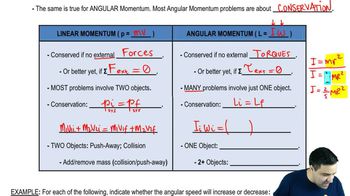
Angular Deceleration

Angular deceleration refers to the rate at which an object's angular velocity decreases over time. It is the rotational equivalent of linear acceleration and is necessary to calculate the required torque to stop the rotation. In this problem, knowing the initial angular velocity and the time to stop allows us to find the angular deceleration needed to halt the system.
Video consigliato:
Percorso guidato
12:12
Conservation of Angular Momentum
Pratica correlata
Domanda del libro di testo

The object shown in FIGURE EX12.29 is in equilibrium. What are the magnitudes of F1→\(\overrightarrow{F_1}\)_{} and F2→\(\overrightarrow{F_2}\)_{}?

3217
views
Domanda del libro di testo

A 5.0 kg cat and a 2.0 kg bowl of tuna fish are at opposite ends of the 4.0-m-long seesaw of FIGURE EX12.32. How far to the left of the pivot must a 4.0 kg cat stand to keep the seesaw balanced?

2211
views
Domanda del libro di testo

A 12-cm-diameter, 600 g cylinder, initially at rest, rotates on an axle along its axis. A steady 0.50 N force applied tangent to the edge of the cylinder causes the cylinder to reach an angular velocity of 500 rpm in 2.0 s. What is the magnitude of the frictional torque between the cylinder and the axle?

2679
views
Domanda del libro di testo

An object whose moment of inertia is 4.0 kg m2 is rotating with angular velocity 0.25 rad/s. It then experiences the torque shown in FIGURE EX12.25. What is the object's angular velocity at t = 3.0s?

3322
views
1
rank
Domanda del libro di testo

An object's moment of inertia is 2.0 kg m2. Its angular velocity is increasing at the rate of 4.0 rad/s per second. What is the net torque on the object?

2251
views
Domanda del libro di testo

A 4.0-m-long, 500 kg steel beam extends horizontally from the point where it has been bolted to the framework of a new building under construction. A 70 kg construction worker stands at the far end of the beam. What is the magnitude of the torque about the bolt due to the worker and the weight of the beam?

2400
views