Ch 12: Rotation of a Rigid Body
Knight Calc - Physics for Scientists and Engineers 5th Edition
Knight Calc5th EditionPhysics for Scientists and EngineersISBN: 9780137344796Non è quello che usi tu?Cambia libro di testo
Capitolo 12, Problema 27

A 12-cm-diameter, 600 g cylinder, initially at rest, rotates on an axle along its axis. A steady 0.50 N force applied tangent to the edge of the cylinder causes the cylinder to reach an angular velocity of 500 rpm in 2.0 s. What is the magnitude of the frictional torque between the cylinder and the axle?

Guida verificata passo dopo passo
1
Determine the moment of inertia of the cylinder. For a solid cylinder rotating about its central axis, the moment of inertia is given by \( I = \frac{1}{2} m r^2 \), where \( m \) is the mass of the cylinder and \( r \) is its radius. Convert the diameter (12 cm) to radius (6 cm or 0.06 m) and use the mass (600 g or 0.6 kg) to calculate \( I \).
Calculate the angular acceleration \( \alpha \) of the cylinder. Use the kinematic equation \( \omega_f = \omega_i + \alpha t \), where \( \omega_f \) is the final angular velocity, \( \omega_i \) is the initial angular velocity (0 rad/s since it starts from rest), and \( t \) is the time (2.0 s). Convert the final angular velocity from rpm (500 rpm) to rad/s using \( \omega_f = \text{rpm} \times \frac{2\pi}{60} \). Solve for \( \alpha \).
Determine the net torque acting on the cylinder using the rotational analog of Newton's second law: \( \tau_{\text{net}} = I \alpha \). Substitute the values of \( I \) and \( \alpha \) calculated in the previous steps to find \( \tau_{\text{net}} \).
Calculate the applied torque due to the tangential force. Torque is given by \( \tau_{\text{applied}} = F r \), where \( F \) is the tangential force (0.50 N) and \( r \) is the radius of the cylinder (0.06 m).
Find the frictional torque by subtracting the applied torque from the net torque. Use \( \tau_{\text{friction}} = \tau_{\text{applied}} - \tau_{\text{net}} \). The result will give the magnitude of the frictional torque opposing the motion.

Risposta video verificata per un problema simile:

Questa soluzione video è stata consigliata dai nostri tutor come utile per risolvere questo problema.
Durata del video:
9m

Concetti chiave

Ecco i concetti essenziali che devi comprendere per rispondere correttamente alla domanda.

Torque

Torque is a measure of the rotational force applied to an object, calculated as the product of the force and the distance from the pivot point (lever arm). In this scenario, the torque generated by the applied force can be determined using the formula τ = r × F, where τ is torque, r is the radius of the cylinder, and F is the force applied tangentially.
Video consigliato:
Percorso guidato
08:55
Net Torque & Sign of Torque

Moment of Inertia

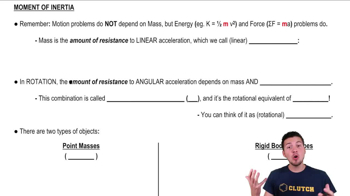
The moment of inertia is a property of a body that quantifies its resistance to angular acceleration about an axis. For a solid cylinder, it is calculated using the formula I = (1/2) m r², where m is the mass and r is the radius. Understanding the moment of inertia is crucial for analyzing how the cylinder responds to applied torques.
Video consigliato:
Percorso guidato
11:47
Intro to Moment of Inertia

Angular Acceleration

Angular acceleration is the rate of change of angular velocity over time, typically measured in radians per second squared (rad/s²). It can be calculated using the formula α = (ω_f - ω_i) / t, where ω_f is the final angular velocity, ω_i is the initial angular velocity, and t is the time taken. This concept is essential for determining the net torque acting on the cylinder, including the effects of friction.
Video consigliato:
Percorso guidato
12:12
Conservation of Angular Momentum