
Ch 12: Rotation of a Rigid Body
Knight Calc - Physics for Scientists and Engineers 5th Edition
Knight Calc5th EditionPhysics for Scientists and EngineersISBN: 9780137344796Non è quello che usi tu?Cambia libro di testo
Capitolo 12, Problema 45

A 2.0 kg, 20-cm-diameter turntable rotates at 100 rpm on frictionless bearings. Two 500 g blocks fall from above, hit the turntable simultaneously at opposite ends of a diameter, and stick. What is the turntable's angular velocity, in rpm, just after this event?

Guida verificata passo dopo passo
1
Step 1: Identify the principle of conservation of angular momentum. Since there are no external torques acting on the system, the total angular momentum before and after the blocks stick to the turntable must be conserved.
Step 2: Calculate the initial angular momentum of the turntable. Use the formula for the moment of inertia of a solid disk: I=12MR2, where M is the mass of the turntable and R is its radius. Then multiply the moment of inertia by the initial angular velocity (converted to radians per second) to find the initial angular momentum.
Step 3: Determine the moment of inertia of the system after the blocks stick to the turntable. The blocks can be treated as point masses located at a distance R from the axis of rotation. Add their contributions to the moment of inertia using the formula I=mR2, where m is the mass of each block.
Step 4: Apply the conservation of angular momentum. Set the initial angular momentum of the turntable equal to the final angular momentum of the system (turntable + blocks). Use the formula L=Iω, where ω is the angular velocity. Solve for the final angular velocity ω.
Step 5: Convert the final angular velocity from radians per second back to revolutions per minute (rpm) using the conversion factor 602π. This will give the turntable's angular velocity in rpm after the blocks stick.

Risposta video verificata per un problema simile:

Questa soluzione video è stata consigliata dai nostri tutor come utile per risolvere questo problema.

Concetti chiave

Ecco i concetti essenziali che devi comprendere per rispondere correttamente alla domanda.

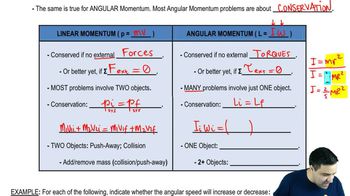
Conservation of Angular Momentum

The principle of conservation of angular momentum states that if no external torque acts on a system, the total angular momentum of that system remains constant. In this scenario, the initial angular momentum of the turntable must equal the final angular momentum after the blocks stick to it, allowing us to calculate the new angular velocity.
Video consigliato:
Percorso guidato
12:12
Conservation of Angular Momentum

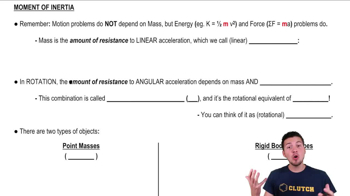
Moment of Inertia

The moment of inertia is a measure of an object's resistance to changes in its rotation and depends on the mass distribution relative to the axis of rotation. For the turntable and the added blocks, we need to calculate the total moment of inertia before and after the blocks land to determine the new angular velocity.
Video consigliato:
Percorso guidato
11:47
Intro to Moment of Inertia

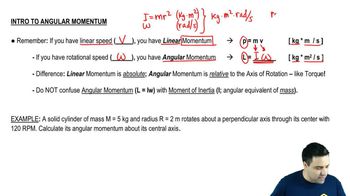
Angular Velocity

Angular velocity is a vector quantity that represents the rate of rotation of an object around an axis, typically measured in radians per second or revolutions per minute (rpm). In this problem, we need to find the new angular velocity of the turntable after the blocks have been added, which will involve using the conservation of angular momentum and the calculated moment of inertia.
Video consigliato:
Percorso guidato
06:18
Intro to Angular Momentum