
Ch 12: Rotation of a Rigid Body
Knight Calc - Physics for Scientists and Engineers 5th Edition
Knight Calc5th EditionPhysics for Scientists and EngineersISBN: 9780137344796Non è quello che usi tu?Cambia libro di testo
Capitolo 12, Problema 43

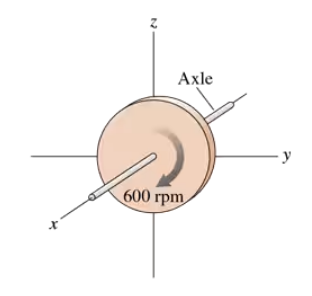
What is the angular momentum vector of the 2.0 kg, 4.0-cm-diameter rotating disk in FIGURE EX12.43? Give your answer using unit vectors.

Guida verificata passo dopo passo
1
Step 1: Understand the concept of angular momentum. Angular momentum ( L ) for a rotating object is given by the formula: L = I ω , where I is the moment of inertia and ω is the angular velocity.
Step 2: Calculate the moment of inertia ( I ) for the disk. For a solid disk rotating about its central axis, the formula for the moment of inertia is: I = 0.5 m r 2 , where m is the mass of the disk and r is its radius. The radius can be calculated as half the diameter: r = 0.04 / 2 = 0.02 m.
Step 3: Determine the angular velocity ( ω ). The problem may provide the rotational speed in revolutions per minute (rpm) or another unit. Convert this value to radians per second using the conversion factor: 1 rpm = 2π / 60 radians per second.
Step 4: Multiply the moment of inertia ( I ) by the angular velocity ( ω ) to find the angular momentum ( L ): L = I ω . Ensure the units are consistent (e.g., kg·m²/s).
Step 5: Express the angular momentum vector using unit vectors. The direction of the angular momentum vector is determined by the right-hand rule, which depends on the rotation axis of the disk. If the disk rotates counterclockwise when viewed from above, the angular momentum vector points upward along the positive z-axis. Represent the vector as: L = L k , where k is the unit vector in the z-direction.

Risposta video verificata per un problema simile:

Questa soluzione video è stata consigliata dai nostri tutor come utile per risolvere questo problema.
Durata del video:
4m

Concetti chiave

Ecco i concetti essenziali che devi comprendere per rispondere correttamente alla domanda.

Angular Momentum

Angular momentum is a vector quantity that represents the rotational inertia and rotational velocity of an object. It is calculated as the product of the moment of inertia and the angular velocity. For a rotating disk, the angular momentum vector points along the axis of rotation, following the right-hand rule, and its magnitude depends on the mass distribution and the speed of rotation.
Video consigliato:
Percorso guidato
06:18
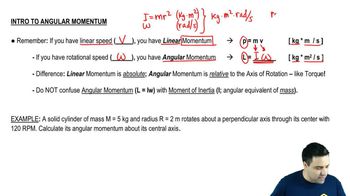
Intro to Angular Momentum

Moment of Inertia

The moment of inertia is a measure of an object's resistance to changes in its rotational motion. It depends on the mass of the object and the distribution of that mass relative to the axis of rotation. For a solid disk, the moment of inertia can be calculated using the formula I = (1/2) m r², where m is the mass and r is the radius of the disk.
Video consigliato:
Percorso guidato
11:47
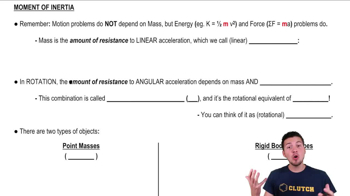
Intro to Moment of Inertia

Unit Vectors

Unit vectors are vectors with a magnitude of one, used to indicate direction in space. In three-dimensional space, unit vectors are typically represented as i, j, and k, corresponding to the x, y, and z axes, respectively. When expressing angular momentum in terms of unit vectors, it is essential to decompose the vector into its components along these axes to provide a clear and precise representation of its direction and magnitude.
Video consigliato: