
Ch 12: Rotation of a Rigid Body
Knight Calc - Physics for Scientists and Engineers 5th Edition
Knight Calc5th EditionPhysics for Scientists and EngineersISBN: 9780137344796Non è quello che usi tu?Cambia libro di testo
Capitolo 12, Problema 73b

A long, thin rod of mass M and length L is standing straight up on a table. Its lower end rotates on a frictionless pivot. A very slight push causes the rod to fall over. As it hits the table, what are the speed of the tip of the rod?

Guida verificata passo dopo passo
1
Start by identifying the type of motion involved. The rod rotates about the pivot point as it falls, so this is a rotational dynamics problem. The key is to use the principle of conservation of energy to relate the potential energy of the rod to its rotational kinetic energy as it falls.
Write the expression for the initial potential energy of the rod. The center of mass of the rod is located at a height of \( \frac{L}{2} \) above the table. The potential energy is given by \( U = M g \frac{L}{2} \), where \( M \) is the mass of the rod, \( g \) is the acceleration due to gravity, and \( L \) is the length of the rod.
As the rod falls, its potential energy is converted into rotational kinetic energy. The rotational kinetic energy is given by \( K = \frac{1}{2} I \omega^2 \), where \( I \) is the moment of inertia of the rod about the pivot point, and \( \omega \) is the angular velocity of the rod just before it hits the table. For a rod pivoting about one end, the moment of inertia is \( I = \frac{1}{3} M L^2 \).
Apply the conservation of energy principle: \( U_{initial} = K_{final} \). Substituting the expressions for potential energy and rotational kinetic energy, we get \( M g \frac{L}{2} = \frac{1}{2} \left( \frac{1}{3} M L^2 \right) \omega^2 \). Simplify this equation to solve for \( \omega \), the angular velocity of the rod just before it hits the table.
Finally, calculate the speed of the tip of the rod. The tip of the rod is at a distance \( L \) from the pivot point, so its linear speed is related to the angular velocity by \( v_{tip} = \omega L \). Substitute the value of \( \omega \) obtained in the previous step into this equation to find \( v_{tip} \).

Risposta video verificata per un problema simile:

Questa soluzione video è stata consigliata dai nostri tutor come utile per risolvere questo problema.
Durata del video:
10m

Concetti chiave

Ecco i concetti essenziali che devi comprendere per rispondere correttamente alla domanda.

Rotational Motion

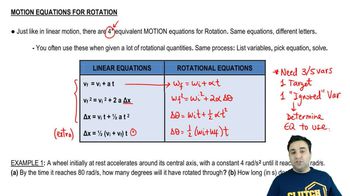
Rotational motion refers to the movement of an object around a central point or axis. In this scenario, the rod rotates about a pivot point at its lower end. Understanding how rotational motion works, including concepts like angular velocity and acceleration, is crucial for analyzing the dynamics of the falling rod.
Video consigliato:
Percorso guidato
07:18
Equations of Rotational Motion

Conservation of Energy

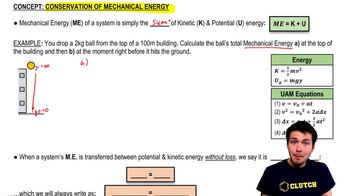
The principle of conservation of energy states that energy cannot be created or destroyed, only transformed from one form to another. As the rod falls, its potential energy is converted into kinetic energy. This concept is essential for calculating the speed of the tip of the rod at the moment it strikes the table.
Video consigliato:
Percorso guidato
06:24
Conservation Of Mechanical Energy

Kinematics of Rigid Bodies

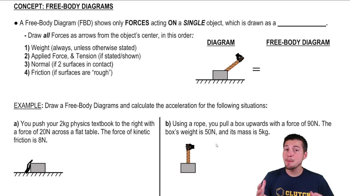
Kinematics of rigid bodies involves the study of the motion of solid objects without considering the forces that cause the motion. In this case, analyzing the motion of the rod as it falls and the relationship between its angular displacement and the linear speed of its tip is key to determining the speed at impact.
Video consigliato:
Percorso guidato
08:42
Free-Body Diagrams
Pratica correlata
Domanda del libro di testo

A solid spherical marble shot up a frictionless 15° slope rolls 2.50 m to its highest point. If the marble is shot with the same speed up a slightly rough 15° slope, it rolls only 2.30 m. What is the coefficient of rolling friction on the second slope?

1640
views
Domanda del libro di testo

The sphere of mass M and radius R in FIGURE P12.75 is rigidly attached to a thin rod of radius r that passes through the sphere at distance (1/2)R from the center. A string wrapped around the rod pulls with tension T. Find an expression for the sphere's angular acceleration. The rod's moment of inertia is negligible.

2019
views
Domanda del libro di testo

The 5.0 kg, 60-cm-diameter disk in FIGURE P12.71 rotates on an axle passing through one edge. The axle is parallel to the floor. The cylinder is held with the center of mass at the same height as the axle, then released. What is the cylinder's angular velocity when it is directly below the axle?

437
views
Domanda del libro di testo

A long, thin rod of mass M and length L is standing straight up on a table. Its lower end rotates on a frictionless pivot. A very slight push causes the rod to fall over. As it hits the table, what are the angular velocity

1863
views
Domanda del libro di testo

A satellite follows the elliptical orbit shown in FIGURE P12.77. The only force on the satellite is the gravitational attraction of the planet. The satellite's speed at point 1 is 8000 m/s. What is the satellite's speed at point 2?

1554
views
Domanda del libro di testo

A satellite follows the elliptical orbit shown in FIGURE P12.77. The only force on the satellite is the gravitational attraction of the planet. The satellite's speed at point 1 is 8000 m/s. Does the satellite experience any torque about the center of the planet? Explain.

1985
views