Ch 12: Rotation of a Rigid Body
Knight Calc - Physics for Scientists and Engineers 5th Edition
Knight Calc5th EditionPhysics for Scientists and EngineersISBN: 9780137344796Non è quello che usi tu?Cambia libro di testo
Capitolo 12, Problema 72

A solid spherical marble shot up a frictionless 15° slope rolls 2.50 m to its highest point. If the marble is shot with the same speed up a slightly rough 15° slope, it rolls only 2.30 m. What is the coefficient of rolling friction on the second slope?

Guida verificata passo dopo passo
1
Identify the forces acting on the marble on the slightly rough slope: gravity, normal force, and rolling friction. The work done by rolling friction is responsible for the reduced distance traveled.
Use the work-energy principle: the initial kinetic energy of the marble is converted into gravitational potential energy and work done against rolling friction. Write the equation: \( KE_{initial} = PE_{final} + W_{friction} \).
Express the gravitational potential energy \( PE_{final} \) as \( m g h \), where \( h \) is the height reached. Use trigonometry to relate \( h \) to the distance \( d \) traveled up the slope: \( h = d \sin(\theta) \), where \( \theta = 15° \).
The work done by rolling friction is \( W_{friction} = f_r d \), where \( f_r \) is the rolling friction force. The rolling friction force is given by \( f_r = \mu_r N \), where \( \mu_r \) is the coefficient of rolling friction and \( N = m g \cos(\theta) \) is the normal force.
Combine the equations and solve for \( \mu_r \): \( \mu_r = \frac{g (d_1 \sin(\theta) - d_2 \sin(\theta))}{g \cos(\theta) d_2} \), where \( d_1 = 2.50 \ \mathrm{m} \) (distance on the frictionless slope) and \( d_2 = 2.30 \ \mathrm{m} \) (distance on the rough slope). Simplify the expression to find \( \mu_r \).

Risposta video verificata per un problema simile:

Questa soluzione video è stata consigliata dai nostri tutor come utile per risolvere questo problema.
Durata del video:
18m

Concetti chiave

Ecco i concetti essenziali che devi comprendere per rispondere correttamente alla domanda.

Rolling Motion

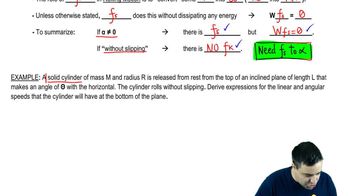
Rolling motion occurs when an object rotates about an axis while translating along a surface. For a solid sphere, the motion involves both translational kinetic energy and rotational kinetic energy. The dynamics of rolling motion are influenced by factors such as friction, which affects how far the object can travel on an incline.
Video consigliato:
Percorso guidato
12:26
Conservation of Energy in Rolling Motion

Friction and Coefficient of Friction

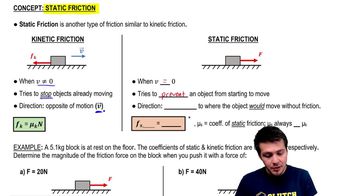
Friction is the force that opposes the relative motion of two surfaces in contact. The coefficient of friction quantifies this resistance and varies depending on the materials involved. In the context of rolling objects, the coefficient of rolling friction is crucial for determining how much distance a rolling object can cover on a slope, especially when comparing different surfaces.
Video consigliato:
Percorso guidato
08:11
Static Friction & Equilibrium

Energy Conservation

The principle of energy conservation states that energy cannot be created or destroyed, only transformed from one form to another. In this scenario, the initial kinetic energy of the marble is converted into gravitational potential energy as it rolls up the slope. The difference in distances traveled on the two slopes can be attributed to the work done against friction, which reduces the energy available for ascent.
Video consigliato:
Percorso guidato
06:24
Conservation Of Mechanical Energy
Pratica correlata
Domanda del libro di testo

A long, thin rod of mass M and length L is standing straight up on a table. Its lower end rotates on a frictionless pivot. A very slight push causes the rod to fall over. As it hits the table, what are the speed of the tip of the rod?

1295
views
Domanda del libro di testo

The sphere of mass M and radius R in FIGURE P12.75 is rigidly attached to a thin rod of radius r that passes through the sphere at distance (1/2)R from the center. A string wrapped around the rod pulls with tension T. Find an expression for the sphere's angular acceleration. The rod's moment of inertia is negligible.

2019
views
Domanda del libro di testo

The 5.0 kg, 60-cm-diameter disk in FIGURE P12.71 rotates on an axle passing through one edge. The axle is parallel to the floor. The cylinder is held with the center of mass at the same height as the axle, then released. What is the cylinder's angular velocity when it is directly below the axle?

437
views
Domanda del libro di testo

A 750 g disk and a 760 g ring, both 15 cm in diameter, are rolling along a horizontal surface at 1.5 m/s when they encounter a 15° slope. How far up the slope does each travel before rolling back down?

2376
views
Domanda del libro di testo

Your engineering team has been assigned the task of measuring the properties of a new jet-engine turbine. You've previously determined that the turbine's moment of inertia is 2.6 kg m2. The next job is to measure the frictional torque of the bearings. Your plan is to run the turbine up to a predetermined rotation speed, cut the power, and time how long it takes the turbine to reduce its rotation speed by 50%. Your data are given in the table. Draw an appropriate graph of the data and, from the slope of the best-fit line, determine the frictional torque.

1333
views
Domanda del libro di testo

A long, thin rod of mass M and length L is standing straight up on a table. Its lower end rotates on a frictionless pivot. A very slight push causes the rod to fall over. As it hits the table, what are the angular velocity

1863
views