Ch 12: Rotation of a Rigid Body
Knight Calc - Physics for Scientists and Engineers 5th Edition
Knight Calc5th EditionPhysics for Scientists and EngineersISBN: 9780137344796Non è quello che usi tu?Cambia libro di testo
Capitolo 12, Problema 4

An 18-cm-long bicycle crank arm, with a pedal at one end, is attached to a 20-cm-diameter sprocket, the toothed disk around which the chain moves. A cyclist riding this bike increases her pedaling rate from 60 rpm to 90 rpm in 10 s. What is the tangential acceleration of a tooth on the sprocket?

Guida verificata passo dopo passo
1
Step 1: Identify the given quantities and their units. The length of the crank arm is 18 cm, the diameter of the sprocket is 20 cm (radius = 10 cm), the initial pedaling rate is 60 rpm, the final pedaling rate is 90 rpm, and the time interval for the change is 10 s.
Step 2: Convert the pedaling rates from revolutions per minute (rpm) to angular velocity in radians per second. Use the formula \( \omega = \frac{2\pi \times \text{rpm}}{60} \). Calculate \( \omega_{\text{initial}} \) and \( \omega_{\text{final}} \).
Step 3: Determine the angular acceleration \( \alpha \) of the sprocket using the formula \( \alpha = \frac{\omega_{\text{final}} - \omega_{\text{initial}}}{\Delta t} \), where \( \Delta t \) is the time interval (10 s).
Step 4: Relate the tangential acceleration \( a_{\text{tangential}} \) to the angular acceleration \( \alpha \) using the formula \( a_{\text{tangential}} = \alpha \cdot r \), where \( r \) is the radius of the sprocket (10 cm).
Step 5: Substitute the values for \( \alpha \) and \( r \) into the formula for \( a_{\text{tangential}} \) to express the tangential acceleration of a tooth on the sprocket.

Risposta video verificata per un problema simile:

Questa soluzione video è stata consigliata dai nostri tutor come utile per risolvere questo problema.
Durata del video:
5m

Concetti chiave

Ecco i concetti essenziali che devi comprendere per rispondere correttamente alla domanda.

Tangential Acceleration

Tangential acceleration refers to the rate of change of tangential velocity of an object moving along a circular path. It is calculated as the product of the radius of the circular path and the angular acceleration. In this context, it helps determine how quickly a point on the sprocket is speeding up as the cyclist increases her pedaling rate.
Video consigliato:
Percorso guidato
08:17
Acceleration in 2D

Angular Velocity

Angular velocity is a measure of how quickly an object rotates around a central point, expressed in radians per second or revolutions per minute (rpm). In this scenario, the cyclist's pedaling rate is given in rpm, which must be converted to angular velocity to analyze the motion of the sprocket and its teeth effectively.
Video consigliato:
Percorso guidato
06:18
Intro to Angular Momentum

Relationship Between Linear and Angular Quantities

The relationship between linear and angular quantities is fundamental in rotational motion. The linear velocity (v) of a point on a rotating object is related to the angular velocity (ω) and the radius (r) by the equation v = rω. This relationship is crucial for calculating the tangential acceleration of the sprocket's teeth as the cyclist changes her pedaling rate.
Video consigliato:
Percorso guidato
11:10
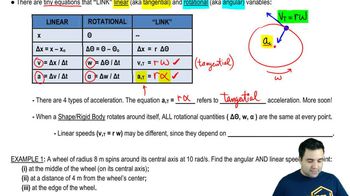
Converting Between Linear & Rotational