Ch 13: Newton's Theory of Gravity
Knight Calc - Physics for Scientists and Engineers 5th Edition
Knight Calc5th EditionPhysics for Scientists and EngineersISBN: 9780137344796Non è quello che usi tu?Cambia libro di testo
Capitolo 13, Problema 4

The International Space Station orbits 300 km above the surface of the earth. What is the gravitational force on a 1.0 kg sphere inside the International Space Station?

Guida verificata passo dopo passo
1
Step 1: Understand the problem. The gravitational force on the sphere is determined by Newton's law of universal gravitation, which states that the force between two masses is proportional to the product of their masses and inversely proportional to the square of the distance between their centers.
Step 2: Write down the formula for gravitational force: F = G * (m₁ * m₂) / r², where G is the gravitational constant (6.674 × 10⁻¹¹ N·m²/kg²), m₁ is the mass of the Earth, m₂ is the mass of the sphere, and r is the distance between the center of the Earth and the sphere.
Step 3: Determine the values for the variables. The mass of the Earth is approximately 5.972 × 10²⁴ kg. The radius of the Earth is approximately 6,371 km, and the sphere is located 300 km above the Earth's surface. Therefore, the total distance r is 6,371 km + 300 km = 6,671 km, which must be converted to meters: r = 6,671 × 10³ m.
Step 4: Substitute the values into the formula. Replace G, m₁, m₂, and r with their respective values: F = (6.674 × 10⁻¹¹) * (5.972 × 10²⁴) * (1.0) / (6,671 × 10³)².
Step 5: Simplify the expression to calculate the gravitational force. Perform the arithmetic operations step by step, ensuring proper handling of exponents and units. The result will give the gravitational force in newtons (N).

Risposta video verificata per un problema simile:

Questa soluzione video è stata consigliata dai nostri tutor come utile per risolvere questo problema.
Durata del video:
4m

Concetti chiave

Ecco i concetti essenziali che devi comprendere per rispondere correttamente alla domanda.

Gravitational Force

Gravitational force is the attractive force between two masses, described by Newton's law of universal gravitation. It states that the force is directly proportional to the product of the two masses and inversely proportional to the square of the distance between their centers. This force is what keeps objects in orbit, including the International Space Station (ISS) around the Earth.
Video consigliato:
Percorso guidato
05:41
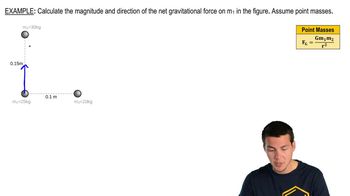
Gravitational Forces in 2D

Weightlessness in Orbit

Weightlessness, or microgravity, occurs when an object is in free fall, such as when the ISS orbits the Earth. Although gravity is still present, the ISS and everything inside it, including a 1.0 kg sphere, are falling towards Earth at the same rate, creating the sensation of weightlessness. This condition affects how gravitational force is perceived by objects inside the ISS.
Video consigliato:
Percorso guidato
04:45
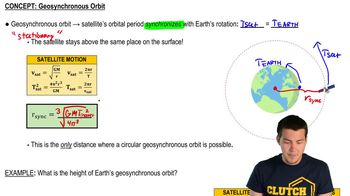
Geosynchronous Orbits

Altitude and Gravitational Acceleration

Gravitational acceleration decreases with altitude, but it does not become zero. At 300 km above Earth's surface, the gravitational acceleration is approximately 9.1 m/s², compared to 9.81 m/s² at sea level. This reduction is important for calculating the gravitational force acting on objects in the ISS, as it directly influences the force experienced by the 1.0 kg sphere.
Video consigliato:
Percorso guidato
07:32
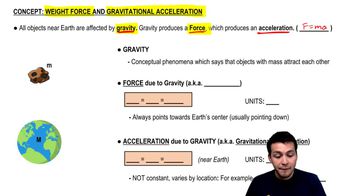
Weight Force & Gravitational Acceleration