Ch 13: Newton's Theory of Gravity
Knight Calc - Physics for Scientists and Engineers 5th Edition
Knight Calc5th EditionPhysics for Scientists and EngineersISBN: 9780137344796Non è quello che usi tu?Cambia libro di testo
Capitolo 13, Problema 5

What is the force of attraction between a 50 kg woman and a 70 kg man sitting 1.0 m apart?

Guida verificata passo dopo passo
1
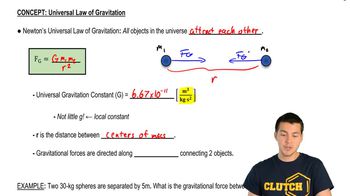
Step 1: Identify the formula for gravitational force. The force of attraction between two masses is given by Newton's law of universal gravitation: F=Gm1m2r2, where G is the gravitational constant, m1 and m2 are the masses, and r is the distance between them.
Step 2: Substitute the known values into the formula. The gravitational constant G is approximately 6.674×10⁻¹¹⁢N⁢m2/kg2. The masses are m1=50 kg and m2=70 kg, and the distance is r=1.0 m.
Step 3: Plug the values into the formula: F=6.674×10⁻¹¹⁢50⁢701.02. This step involves substituting the values for G, m1, m2, and r into the equation.
Step 4: Simplify the numerator. Multiply 6.674×10-11 by 50 and 70 to calculate the product in the numerator.
Step 5: Divide the result by the square of the distance. Since r=1.0, the square of the distance is 1.02. Perform the division to find the force of attraction.

Risposta video verificata per un problema simile:

Questa soluzione video è stata consigliata dai nostri tutor come utile per risolvere questo problema.
Durata del video:
2m

Concetti chiave

Ecco i concetti essenziali che devi comprendere per rispondere correttamente alla domanda.

Newton's Law of Universal Gravitation

Newton's Law of Universal Gravitation states that every point mass attracts every other point mass in the universe with a force that is directly proportional to the product of their masses and inversely proportional to the square of the distance between their centers. This law can be mathematically expressed as F = G(m1*m2)/r^2, where F is the gravitational force, G is the gravitational constant, m1 and m2 are the masses, and r is the distance between them.
Video consigliato:
Percorso guidato
04:05
Universal Law of Gravitation

Gravitational Constant

The gravitational constant, denoted as G, is a fundamental physical constant used in the calculation of gravitational forces between two objects. Its approximate value is 6.674 × 10^-11 N(m/kg)^2. This constant is crucial for quantifying the strength of the gravitational attraction in Newton's Law of Universal Gravitation, allowing us to calculate the force between two masses at a given distance.
Video consigliato:
Percorso guidato
08:59
Phase Constant of a Wave Function

Mass and Weight

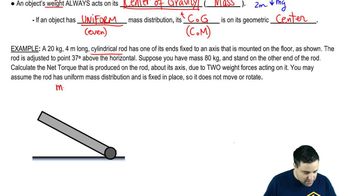
Mass is a measure of the amount of matter in an object, typically measured in kilograms (kg), while weight is the force exerted by gravity on that mass. Weight can be calculated using the formula W = mg, where W is weight, m is mass, and g is the acceleration due to gravity (approximately 9.81 m/s² on Earth). Understanding the distinction between mass and weight is essential for applying gravitational concepts correctly.
Video consigliato:
Percorso guidato
10:19
Torque Due to Weight