
Ch 14: Fluids and Elasticity
Knight Calc - Physics for Scientists and Engineers 5th Edition
Knight Calc5th EditionPhysics for Scientists and EngineersISBN: 9780137344796Non è quello che usi tu?Cambia libro di testo
Capitolo 14, Problema 62

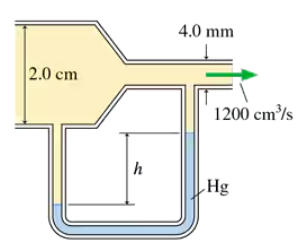
Air flows through the tube shown in FIGURE P14.62 at a rate of 1200 cm³/s. Assume that air is an ideal fluid. What is the height h of mercury in the right side of the U-tube?

Guida verificata passo dopo passo
1
Step 1: Apply the principle of conservation of mass (continuity equation) to the air flow through the tube. The continuity equation states that the mass flow rate is constant, so the product of the cross-sectional area and velocity at one point equals the product at another point. Use the formula: Av=Av, where A is the cross-sectional area and v is the velocity.
Step 2: Calculate the cross-sectional areas of the two sections of the tube using the formula for the area of a circle: A=πr2. For the first section, the radius is 1.5 mm (convert to cm: 0.15 cm), and for the second section, the radius is 3.5 cm.
Step 3: Use the continuity equation to find the velocity of air in each section of the tube. The flow rate is given as 1200 cm³/s, so the velocity can be calculated using v=QA, where Q is the flow rate and A is the cross-sectional area.
Step 4: Apply Bernoulli's equation to relate the pressures in the two sections of the tube. Bernoulli's equation is given as: P+12ρv2=P+12ρv2, where P is pressure, ρ is the density of air, and v is velocity.
Step 5: Relate the pressure difference to the height difference in the mercury column using the hydrostatic pressure formula: ΔP=ρgh, where ΔP is the pressure difference, ρ is the density of mercury, g is the acceleration due to gravity, and h is the height difference. Solve for h.

Risposta video verificata per un problema simile:

Questa soluzione video è stata consigliata dai nostri tutor come utile per risolvere questo problema.
Durata del video:
12m

Concetti chiave

Ecco i concetti essenziali che devi comprendere per rispondere correttamente alla domanda.

Bernoulli's Principle

Bernoulli's Principle states that in a flowing fluid, an increase in the fluid's speed occurs simultaneously with a decrease in pressure or potential energy. This principle is crucial for understanding how the velocity of air flowing through the tube affects the pressure difference between the two sides of the U-tube, ultimately influencing the height of the mercury column.
Video consigliato:
Percorso guidato
14:47
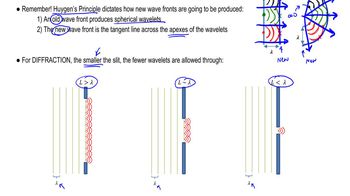
Diffraction with Huygen's Principle

Continuity Equation

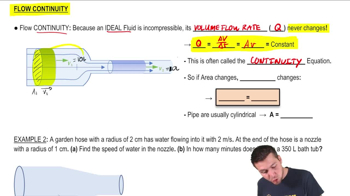
The Continuity Equation is based on the principle of conservation of mass, which states that for an incompressible fluid, the mass flow rate must remain constant from one cross-section of a tube to another. In this scenario, it helps determine the relationship between the cross-sectional areas and velocities of air at different points in the tube, which is essential for calculating the pressure difference.
Video consigliato:
Percorso guidato
11:08
Flow Continuity

Hydrostatic Pressure

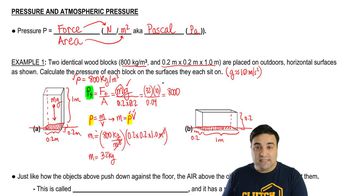
Hydrostatic Pressure refers to the pressure exerted by a fluid at rest due to the weight of the fluid above it. In the context of the U-tube, the height difference of the mercury column (Δh) is directly related to the hydrostatic pressure created by the air flow, allowing us to calculate the height of mercury based on the pressure difference established by the flowing air.
Video consigliato:
Percorso guidato
17:04
Pressure and Atmospheric Pressure
Pratica correlata
Domanda del libro di testo

Water from a vertical pipe emerges as a 10-cm-diameter cylinder and falls straight down 7.5 m into a bucket. The water exits the pipe with a speed of 2.0 m/s. What is the diameter of the column of water as it hits the bucket?

2002
views
Domanda del libro di testo

A water tank of height h has a small hole at height y. The water is replenished to keep h from changing. The water squirting from the hole has range 𝓍. The range approaches zero as y → 0 because the water squirts right onto the ground. The range also approaches zero as y → h because the horizontal velocity becomes zero. Thus there must be some height y between 0 and h for which the range is a maximum. Find an algebraic expression for the flow speed v with which the water exits the hole at height y.

2324
views
Domanda del libro di testo

Air flows through the tube shown in FIGURE P14.63. Assume that air is an ideal fluid. What is the volume flow rate?

3093
views
1
rank
Domanda del libro di testo

A tree loses water to the air by the process of transpiration at the rate of 110 g/h. This water is replaced by the upward flow of sap through vessels in the trunk. If the trunk contains 2000 vessels, each 100 μm in diameter, what is the upward speed in mm/s of the sap in each vessel? The density of tree sap is 1040 kg/m³.

1525
views
Domanda del libro di testo

A cylindrical tank of radius 𝑅, filled to the top with a liquid, has a small hole in the side, of radius 𝓇, at distance d below the surface. Find an expression for the volume flow rate through the hole.

2771
views
Domanda del libro di testo

A hurricane wind blows across a 6.0 m x 15.0 m flat roof at a speed of 130 km/h. What is the pressure difference?

2214
views
1
rank