

Ch 15: Oscillations
Knight Calc - Physics for Scientists and Engineers 5th Edition
Knight Calc5th EditionPhysics for Scientists and EngineersISBN: 9780137344796Non è quello che usi tu?Cambia libro di testo
Capitolo 15, Problema 3

An object in SHM oscillates with a period of 4.0 s and an amplitude of 10 cm. How long does the object take to move from x = 0.0 cm to x = 6.0 cm?

Guida verificata passo dopo passo
1
Step 1: Recall the equation for the position of an object in simple harmonic motion (SHM): x=Asin(ωt), where x is the position, A is the amplitude, ω is the angular frequency, and t is the time.
Step 2: Calculate the angular frequency ω using the relationship ω=2π/T, where T is the period. Substitute T=4.0 s into the equation.
Step 3: Rearrange the SHM equation to solve for time t: t=sin-1(xA)ω. Substitute x=6.0 cm and A=10 cm into the equation.
Step 4: Simplify the argument of the sine inverse function: xA=6.010=0.6. Then calculate sin-1(0.6).
Step 5: Divide the result of sin-1(0.6) by the angular frequency ω to find the time t. This gives the time it takes for the object to move from x=0.0 cm to x=6.0 cm.

Risposta video verificata per un problema simile:

Questa soluzione video è stata consigliata dai nostri tutor come utile per risolvere questo problema.
Durata del video:
5m

Concetti chiave

Ecco i concetti essenziali che devi comprendere per rispondere correttamente alla domanda.

Simple Harmonic Motion (SHM)

Simple Harmonic Motion is a type of periodic motion where an object oscillates around an equilibrium position. The motion is characterized by a restoring force proportional to the displacement from the equilibrium, leading to sinusoidal motion. Key parameters include amplitude, period, and frequency, which define the motion's characteristics.
Video consigliato:
Percorso guidato
07:52
Simple Harmonic Motion of Pendulums

Amplitude and Period

Amplitude is the maximum displacement of an object from its equilibrium position in SHM, while the period is the time taken to complete one full cycle of motion. In this case, the amplitude is 10 cm, indicating the maximum distance from the center, and the period of 4.0 s defines how long it takes to return to the same position in the cycle.
Video consigliato:
Percorso guidato
06:28
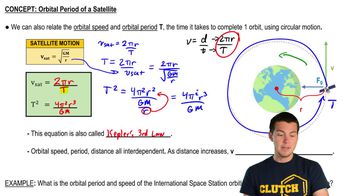
Satellite Period

Position in SHM

The position of an object in SHM can be described using the equation x(t) = A cos(ωt + φ), where A is the amplitude, ω is the angular frequency, and φ is the phase constant. To find the time taken to move from one position to another, we can calculate the corresponding angles and use the period to determine the time interval.
Video consigliato:
Percorso guidato
14:03
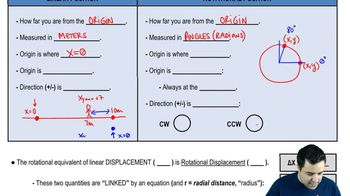
Rotational Position & Displacement