
Ch 15: Oscillations
Knight Calc - Physics for Scientists and Engineers 5th Edition
Knight Calc5th EditionPhysics for Scientists and EngineersISBN: 9780137344796Non è quello che usi tu?Cambia libro di testo
Capitolo 15, Problema 6

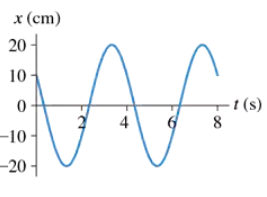
What are the (a) amplitude, (b) frequency, and (c) phase constant of the oscillation shown in FIGURE EX15.6?

Guida verificata passo dopo passo
1
Step 1: Identify the amplitude of the oscillation. The amplitude is the maximum displacement from the equilibrium position (x = 0). From the graph, observe that the maximum displacement is 5 cm. Therefore, the amplitude is 5 cm.
Step 2: Determine the frequency of the oscillation. Frequency is the number of cycles completed per second. First, calculate the period (T), which is the time taken for one complete cycle. From the graph, one cycle starts at t = 0 s and ends at t = 4 s, so T = 4 s. Use the formula for frequency: f = 1/T.
Step 3: Analyze the phase constant. The phase constant determines the initial position and direction of motion at t = 0. From the graph, at t = 0, the displacement x is positive (approximately 2 cm), indicating a cosine function with a phase shift. Use the general equation for simple harmonic motion: x(t) = A cos(ωt + φ), where φ is the phase constant. Compare the graph to this equation to deduce φ.
Step 4: Relate the angular frequency (ω) to the frequency. Angular frequency is given by ω = 2πf. Substitute the frequency calculated in Step 2 into this formula to find ω.
Step 5: Summarize the findings. The amplitude, frequency, and phase constant are determined from the graph and equations. Ensure all units are consistent and verify the interpretation of the graph.

Risposta video verificata per un problema simile:

Questa soluzione video è stata consigliata dai nostri tutor come utile per risolvere questo problema.
Durata del video:
6m

Concetti chiave

Ecco i concetti essenziali che devi comprendere per rispondere correttamente alla domanda.

Amplitude

Amplitude is the maximum displacement of an oscillating object from its equilibrium position. In the context of simple harmonic motion, it represents the peak value of the oscillation, indicating how far the object moves from the center point. For the graph shown, the amplitude can be determined by measuring the maximum vertical distance from the equilibrium line (x=0) to the highest or lowest point of the wave.
Video consigliato:
Percorso guidato
04:24
Amplitude Decay in an LRC Circuit

Frequency

Frequency is the number of complete cycles of oscillation that occur in a unit of time, typically measured in hertz (Hz). It is inversely related to the period of the oscillation, which is the time taken to complete one full cycle. In the provided graph, frequency can be calculated by observing the time it takes for the wave to repeat itself and using the formula f = 1/T, where T is the period.
Video consigliato:
Percorso guidato
05:08
Circumference, Period, and Frequency in UCM

Phase Constant

The phase constant is a parameter that indicates the initial angle or position of the oscillating object at time t=0. It helps to describe the starting point of the oscillation in relation to the sine or cosine function used to model the motion. In the graph, the phase constant can be inferred from the position of the wave at the beginning of the time axis, determining how far the wave has shifted from its standard position.
Video consigliato:
Percorso guidato
08:59
Phase Constant of a Wave Function