Ch 18: A Macroscopic Description of Matter
Knight Calc - Physics for Scientists and Engineers 5th Edition
Knight Calc5th EditionPhysics for Scientists and EngineersISBN: 9780137344796Non è quello che usi tu?Cambia libro di testo
Capitolo 18, Problema 32b

0.10 mol of argon gas is admitted to an evacuated 50 cm3 container at 20°C. The gas then undergoes an isochoric heating to a temperature of 300°C. Show the process on a pV diagram. Include a proper scale on both axes.

Guida verificata passo dopo passo
1
Step 1: Understand the problem. The gas undergoes an isochoric process, meaning the volume remains constant. The initial temperature is 20°C (convert to Kelvin: T₁ = 20 + 273 = 293 K), and the final temperature is 300°C (convert to Kelvin: T₂ = 300 + 273 = 573 K). The volume of the container is 50 cm³, which remains constant throughout the process.
Step 2: Use the ideal gas law to determine the pressure at both temperatures. The ideal gas law is given by: P = (nRT)/V, where n is the number of moles, R is the gas constant (8.314 J/(mol·K)), T is the temperature in Kelvin, and V is the volume in cubic meters. Convert the volume from cm³ to m³: V = 50 cm³ × (1 m³ / 10⁶ cm³) = 50 × 10⁻⁶ m³.
Step 3: Calculate the initial pressure (P₁) using the ideal gas law. Substitute the values: n = 0.10 mol, R = 8.314 J/(mol·K), T₁ = 293 K, and V = 50 × 10⁻⁶ m³. This gives P₁ = (0.10 × 8.314 × 293) / (50 × 10⁻⁶).
Step 4: Calculate the final pressure (P₂) using the ideal gas law. Substitute the values: n = 0.10 mol, R = 8.314 J/(mol·K), T₂ = 573 K, and V = 50 × 10⁻⁶ m³. This gives P₂ = (0.10 × 8.314 × 573) / (50 × 10⁻⁶).
Step 5: Plot the process on a pV diagram. Since the volume remains constant, the graph will be a vertical line at V = 50 cm³ (or 50 × 10⁻⁶ m³). The pressure axis should be scaled to include both P₁ and P₂, and the volume axis should remain fixed at 50 cm³. Label the initial and final pressures on the graph accordingly.

Risposta video verificata per un problema simile:

Questa soluzione video è stata consigliata dai nostri tutor come utile per risolvere questo problema.
Durata del video:
8m

Concetti chiave

Ecco i concetti essenziali che devi comprendere per rispondere correttamente alla domanda.

Isochoric Process

An isochoric process is a thermodynamic process in which the volume of the system remains constant. In this scenario, the argon gas is heated in a fixed-volume container, meaning that any increase in temperature will result in an increase in pressure, as the gas molecules gain kinetic energy and collide more frequently with the walls of the container.
Video consigliato:
Percorso guidato
08:45
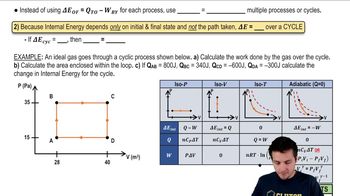
Properties of Cyclic Thermodynamic Processes

Ideal Gas Law

The Ideal Gas Law, expressed as PV = nRT, relates the pressure (P), volume (V), and temperature (T) of an ideal gas, where n is the number of moles and R is the ideal gas constant. This law is crucial for understanding the behavior of the argon gas in the container, as it allows us to calculate changes in pressure resulting from the increase in temperature during the isochoric heating.
Video consigliato:
Percorso guidato
07:21
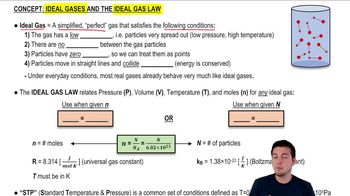
Ideal Gases and the Ideal Gas Law

pV Diagram

A pV diagram is a graphical representation of the relationship between pressure (p) and volume (V) for a given system. In this case, the pV diagram will illustrate the isochoric process of the argon gas, showing a vertical line since the volume remains constant while the pressure increases as the temperature rises from 20°C to 300°C.
Video consigliato:
Percorso guidato
08:07
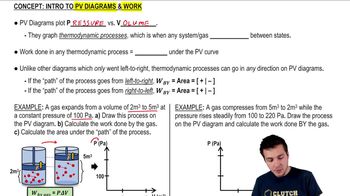
Work and PV Diagrams