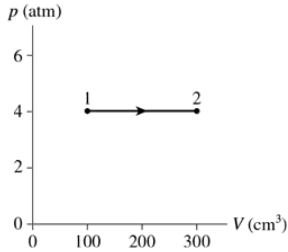
0.0050 mol of gas undergoes the process 1→2→3 shown in FIGURE EX18.37. What are temperature T1?
Ch 18: A Macroscopic Description of Matter
Knight Calc5th EditionPhysics for Scientists and EngineersISBN: 9780137344796Non è quello che usi tu?Cambia libro di testo
Capitolo 18, Problema 35c
A gas with an initial temperature of 900°C undergoes the process shown in FIGURE EX18.35. How many moles of gas are there?

Guida verificata passo dopo passo1
Step 1: Identify the relevant equation for the problem. To find the number of moles of gas, we use the Ideal Gas Law: , where P is pressure, V is volume, n is the number of moles, R is the gas constant, and T is temperature.
Step 2: Convert the given temperature from Celsius to Kelvin. The temperature in Kelvin is calculated using the formula: . For 900°C, this becomes .
Step 3: Extract the values of pressure (P) and volume (V) from the graph. At point 2, the pressure is 4 atm and the volume is 8 L. These values will be used in the Ideal Gas Law.
Step 4: Use the gas constant R in appropriate units. For pressure in atm and volume in liters, the value of R is .
Step 5: Rearrange the Ideal Gas Law to solve for n (number of moles): . Substitute the values for P, V, R, and T into the equation to calculate the number of moles.

Risposta video verificata per un problema simile:
Questa soluzione video è stata consigliata dai nostri tutor come utile per risolvere questo problema.
Durata del video:
5mConcetti chiave
Ecco i concetti essenziali che devi comprendere per rispondere correttamente alla domanda.
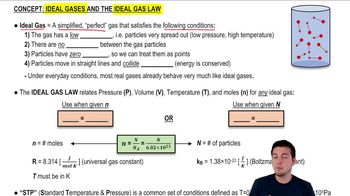
Ideal Gas Law
The Ideal Gas Law is a fundamental equation in thermodynamics that relates the pressure (P), volume (V), number of moles (n), and temperature (T) of an ideal gas. It is expressed as PV = nRT, where R is the ideal gas constant. This law allows us to calculate the number of moles of gas when the other variables are known, making it essential for solving problems involving gas behavior.
Video consigliato:
Percorso guidato
Ideal Gases and the Ideal Gas Law
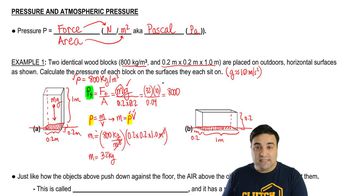
Pressure-Volume Relationship
The pressure-volume relationship of a gas is described by Boyle's Law, which states that at constant temperature, the pressure of a gas is inversely proportional to its volume. This means that if the volume increases, the pressure decreases, and vice versa. Understanding this relationship is crucial for analyzing the graph provided, which illustrates how pressure changes with volume during the gas's transformation.
Video consigliato:
Percorso guidato
Pressure and Atmospheric Pressure
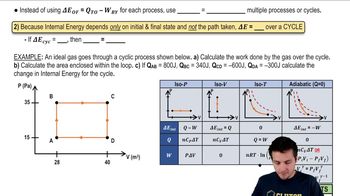
Thermodynamic Processes
Thermodynamic processes describe the changes in state variables of a system, such as temperature, pressure, and volume. In the context of the question, the graph represents a specific process that the gas undergoes, which can be isothermal, adiabatic, or other types. Identifying the type of process is important for applying the correct equations and understanding how the gas behaves under different conditions.
Video consigliato:
Percorso guidato
Properties of Cyclic Thermodynamic Processes
Pratica correlata
Domanda del libro di testo
1570
views
Domanda del libro di testo
0.10 mol of argon gas is admitted to an evacuated 50 cm3 container at 20°C. The gas then undergoes an isochoric heating to a temperature of 300°C. Show the process on a pV diagram. Include a proper scale on both axes.
1702
views
Domanda del libro di testo
0.10 mol of argon gas is admitted to an evacuated 50 cm3 container at 20°C. The gas then undergoes an isochoric heating to a temperature of 300°C. What is the final pressure of the gas?
1873
views
Domanda del libro di testo
A gas with an initial temperature of 900°C undergoes the process shown in FIGURE EX18.35. What type of process is this?
1734
views
Domanda del libro di testo
0.0050 mol of gas undergoes the process 1→2→3 shown in FIGURE EX18.37. What is the volume V3?
1832
views
Domanda del libro di testo
0.0050 mol of gas undergoes the process 1→2→3 shown in FIGURE EX18.37. What are pressure p2?
1643
views