Ch 18: A Macroscopic Description of Matter
Knight Calc - Physics for Scientists and Engineers 5th Edition
Knight Calc5th EditionPhysics for Scientists and EngineersISBN: 9780137344796Non è quello che usi tu?Cambia libro di testo
Capitolo 18, Problema 20a

A cylinder contains nitrogen gas. A piston compresses the gas to half its initial volume. Afterward, has the mass density of the gas changed? If so, by what factor? If not, why not?

Guida verificata passo dopo passo
1
Step 1: Understand the relationship between mass density and volume. Mass density (ρ) is defined as the mass (m) of the gas divided by its volume (V): ρ=mV. The mass of the gas remains constant during compression, but the volume changes.
Step 2: Analyze the effect of halving the volume. If the volume is reduced to half its initial value, the denominator in the density formula decreases, causing the density to increase.
Step 3: Determine the factor by which the density changes. Since the volume is halved, the density will double. Mathematically, if the initial density is ρ0, the new density becomes ρnew=2ρ0.
Step 4: Confirm that the mass remains constant. The mass of the gas does not change during compression because no gas is added or removed from the cylinder.
Step 5: Conclude that the mass density has changed and increased by a factor of 2 due to the halving of the volume.

Risposta video verificata per un problema simile:

Questa soluzione video è stata consigliata dai nostri tutor come utile per risolvere questo problema.
Durata del video:
3m

Concetti chiave

Ecco i concetti essenziali che devi comprendere per rispondere correttamente alla domanda.

Mass Density

Mass density is defined as the mass of a substance per unit volume, typically expressed in kilograms per cubic meter (kg/m³). It is a crucial property that indicates how much mass is contained in a given volume of material. In the context of gases, density can change with variations in pressure and temperature, but remains constant if the mass of the gas does not change.
Video consigliato:
Percorso guidato
04:33
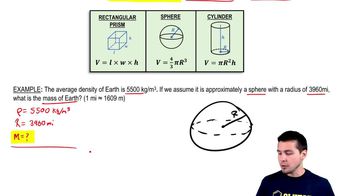
Problems with Mass, Volume, & Density

Ideal Gas Law

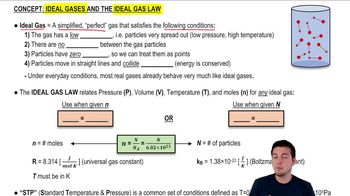
The Ideal Gas Law is a fundamental equation in thermodynamics that relates the pressure, volume, temperature, and number of moles of an ideal gas. It is expressed as PV = nRT, where P is pressure, V is volume, n is the number of moles, R is the ideal gas constant, and T is temperature. This law helps in understanding how changes in volume and pressure affect the behavior of gases, particularly during compression.
Video consigliato:
Percorso guidato
07:21
Ideal Gases and the Ideal Gas Law

Conservation of Mass

The principle of conservation of mass states that mass cannot be created or destroyed in a closed system. In the context of the gas in the cylinder, compressing the gas to half its initial volume does not change the total mass of the gas present. Therefore, while the volume decreases, the mass density increases proportionally, as the same mass is now occupying a smaller volume.
Video consigliato:
Percorso guidato
8:39
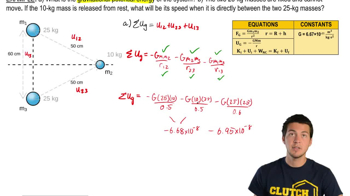
Energy Conservation in Three-Mass System
Pratica correlata
Domanda del libro di testo

A gas at 100°C fills volume V₀. If the pressure is held constant, what is the volume if the Kelvin temperature is doubled?

1561
views

Domanda del libro di testo

A gas at 100°C fills volume V0. If the pressure is held constant, what is the volume if the Celsius temperature is doubled?

1617
views
Domanda del libro di testo

The total lung capacity of a typical adult is 5.0 L. Approximately 20% of the air is oxygen. At sea level and at a body temperature of 37°C, how many oxygen molecules do the lungs contain at the end of a strong inhalation?

2776
views
Domanda del libro di testo

A surveyor has a steel measuring tape that is calibrated to be 100.000 m long (i.e., accurate to ±1 mm) at 20°C. If she measures the distance between two stakes to be 65.175 m on a 3°C day, does she need to add or subtract a correction factor to get the true distance? How large, in mm, is the correction factor?

1622
views
Domanda del libro di testo

At room temperature (20°C), a 5.0-cm-long brass rod is 20 μm too long to fit into a slot. To what temperature should you cool the rod so that it just barely fits?

1940
views
Domanda del libro di testo
Common outdoor thermometers are filled with red-colored ethyl alcohol. One thermometer has a 0.40-mm-diameter capillary tube attached to a 9.0-mm-diameter spherical bulb. On a 0°C morning, the column of alcohol stands 30 mm above the bulb. What is the temperature in °C when the column of alcohol stands 130 mm above the bulb? The expansion of the glass is much less than that of the alcohol and can be ignored.
1761
views
1
rank
1
comments