Ch 18: A Macroscopic Description of Matter
Knight Calc - Physics for Scientists and Engineers 5th Edition
Knight Calc5th EditionPhysics for Scientists and EngineersISBN: 9780137344796Non è quello che usi tu?Cambia libro di testo
Capitolo 18, Problema 23

The total lung capacity of a typical adult is 5.0 L. Approximately 20% of the air is oxygen. At sea level and at a body temperature of 37°C, how many oxygen molecules do the lungs contain at the end of a strong inhalation?

Guida verificata passo dopo passo
1
Step 1: Begin by identifying the key variables in the problem. The total lung capacity is 5.0 L, and 20% of the air is oxygen. The temperature is given as 37°C, which needs to be converted to Kelvin using the formula: \( T(K) = T(°C) + 273.15 \).
Step 2: Use the ideal gas law \( PV = nRT \) to relate the volume, pressure, and temperature to the number of moles of gas. Assume the pressure \( P \) is 1 atm (sea level pressure), \( V \) is 5.0 L, \( R \) is the ideal gas constant \( 0.0821 \, \text{L·atm/(mol·K)} \), and \( T \) is the temperature in Kelvin.
Step 3: Calculate the total number of moles of air \( n \) using the ideal gas law rearranged as \( n = \frac{PV}{RT} \). Substitute the values for \( P \), \( V \), \( R \), and \( T \) into the equation.
Step 4: Determine the number of moles of oxygen by multiplying the total moles of air by the fraction of oxygen in the air (20%, or 0.20). \( n_{\text{oxygen}} = n \times 0.20 \).
Step 5: Convert the moles of oxygen to the number of oxygen molecules using Avogadro's number \( 6.022 \times 10^{23} \, \text{molecules/mol} \). Multiply \( n_{\text{oxygen}} \) by Avogadro's number to find the total number of oxygen molecules in the lungs.

Risposta video verificata per un problema simile:

Questa soluzione video è stata consigliata dai nostri tutor come utile per risolvere questo problema.
Durata del video:
7m

Concetti chiave

Ecco i concetti essenziali che devi comprendere per rispondere correttamente alla domanda.

Total Lung Capacity

Total lung capacity (TLC) is the maximum amount of air the lungs can hold, typically around 5.0 liters for an adult. It includes various lung volumes such as tidal volume, inspiratory reserve volume, and expiratory reserve volume. Understanding TLC is essential for calculating the amount of specific gases, like oxygen, present in the lungs after inhalation.
Video consigliato:
Percorso guidato
05:29
Total Internal Reflection

Gas Composition and Molar Volume

The composition of air at sea level is approximately 78% nitrogen, 21% oxygen, and 1% other gases. The molar volume of an ideal gas at standard temperature and pressure (STP) is about 22.4 liters per mole. This concept is crucial for determining the number of moles of oxygen in the lungs based on the total lung capacity and the percentage of oxygen in the air.
Video consigliato:
Percorso guidato
07:47
Vector Composition & Decomposition

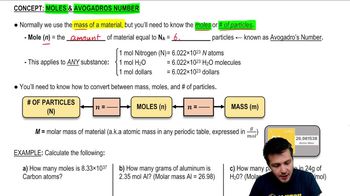
Avogadro's Number

Avogadro's number, approximately 6.022 x 10²³, is the number of molecules in one mole of a substance. This constant allows us to convert moles of a gas into the actual number of molecules. In the context of the question, it is used to find the total number of oxygen molecules present in the lungs after inhalation by multiplying the moles of oxygen by Avogadro's number.
Video consigliato:
Percorso guidato
07:19
Moles & Avogadro's Number