
Ch 18: A Macroscopic Description of Matter
Knight Calc - Physics for Scientists and Engineers 5th Edition
Knight Calc5th EditionPhysics for Scientists and EngineersISBN: 9780137344796Non è quello che usi tu?Cambia libro di testo
Capitolo 18, Problema 57a

The 50 kg circular piston shown in FIGURE P18.57 floats on 0.12 mol of compressed air. What is the piston height h if the temperature is 30°C?

Guida verificata passo dopo passo
1
Convert the given temperature from Celsius to Kelvin using the formula: \( T(K) = T(°C) + 273.15 \). This ensures the temperature is in the correct unit for thermodynamic calculations.
Use the ideal gas law \( PV = nRT \) to relate the pressure \( P \), volume \( V \), number of moles \( n \), gas constant \( R \), and temperature \( T \). Here, \( n = 0.12 \) mol, \( R = 8.314 \ \text{J/(mol·K)} \), and \( T \) is the temperature in Kelvin.
Express the volume \( V \) of the gas in terms of the piston height \( h \). The volume of the gas is the cross-sectional area of the piston \( A \) multiplied by the height \( h \): \( V = A \cdot h \).
Determine the pressure \( P \) exerted by the piston on the gas. The pressure is due to the weight of the piston and is given by \( P = \frac{F}{A} \), where \( F = mg \) is the weight of the piston (\( m = 50 \ \text{kg} \) and \( g = 9.8 \ \text{m/s}^2 \)).
Combine the expressions for \( P \) and \( V \) into the ideal gas law \( PV = nRT \). Substitute \( P = \frac{mg}{A} \) and \( V = A \cdot h \) into the equation, then solve for \( h \) in terms of the given quantities.

Risposta video verificata per un problema simile:

Questa soluzione video è stata consigliata dai nostri tutor come utile per risolvere questo problema.
Durata del video:
7m

Concetti chiave

Ecco i concetti essenziali che devi comprendere per rispondere correttamente alla domanda.

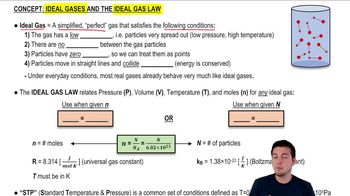
Ideal Gas Law

The Ideal Gas Law relates the pressure, volume, temperature, and number of moles of a gas through the equation PV = nRT. Here, P is pressure, V is volume, n is the number of moles, R is the ideal gas constant, and T is the temperature in Kelvin. This law is essential for determining the behavior of gases under varying conditions, such as the compressed air in the piston.
Video consigliato:
Percorso guidato
07:21
Ideal Gases and the Ideal Gas Law

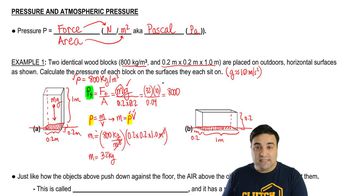
Hydrostatic Pressure

Hydrostatic pressure is the pressure exerted by a fluid at equilibrium due to the force of gravity. It is calculated using the formula P = ρgh, where ρ is the fluid density, g is the acceleration due to gravity, and h is the height of the fluid column. In this context, it helps to understand how the weight of the piston affects the pressure of the air inside.
Video consigliato:
Percorso guidato
17:04
Pressure and Atmospheric Pressure

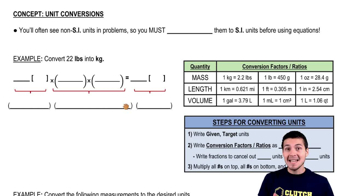
Temperature Conversion

Temperature conversion is crucial for calculations involving the Ideal Gas Law, as temperature must be expressed in Kelvin. The conversion from Celsius to Kelvin is done by adding 273.15 to the Celsius temperature. In this problem, converting the given temperature of 30°C to Kelvin is necessary to apply the Ideal Gas Law correctly.
Video consigliato:
Percorso guidato
07:46
Unit Conversions
Pratica correlata
Domanda del libro di testo

A 10-cm-diameter, 40-cm-tall gas cylinder, sealed at the top by a frictionless 50 kg piston, is surrounded by a bath of 20°C water. Then 50 kg of sand is slowly poured onto the top of the piston, where it stays. Afterward, what is the height of the piston?

1546
views
Domanda del libro di testo

A diver 50 m deep in 10°C fresh water exhales a 1.0-cm-diameter bubble. What is the bubble's diameter just as it reaches the surface of the lake, where the water temperature is 20°C?

1958
views
Domanda del libro di testo

The 50 kg circular piston shown in FIGURE P18.57 floats on 0.12 mol of compressed air. How far does the piston move if the temperature is increased by 100°C?

1560
views
Domanda del libro di testo

In Problems 67,68,69,67, 68, 69, and 7070 you are given the equation(s) used to solve a problem. For each of these, you are to draw a pV diagram.

(T2+273) K=200 kPa500 kPa×1×(400+273) K(T_2 + 273) \(\text{ K}\) = \(\frac{200 \text{ kPa}\)}{500 \(\text{ kPa}\)} \(\times\) 1 \(\times\) (400 + 273) \(\text{ K}\)

1478
views
Domanda del libro di testo

On a cool morning, when the temperature is 15°C, you measure the pressure in your car tires to be 30 psi. After driving 20 mi on the freeway, the temperature of your tires is 45°C . What pressure will your tire gauge now show?

1831
views
Domanda del libro di testo

The interior of a Boeing 737-800 can be modeled as a 32-m-long, 3.7-m-diameter cylinder. The air inside, at cruising altitude, is 20°C at a pressure of 82 kPa. What volume of outside air, at −40°C and a pressure of 23 kPa, must be drawn in, heated, and compressed to fill the plane?

1956
views