
Ch 19: Work, Heat, and the First Law of Thermodynamics
Knight Calc - Physics for Scientists and Engineers 5th Edition
Knight Calc5th EditionPhysics for Scientists and EngineersISBN: 9780137344796Non è quello che usi tu?Cambia libro di testo
Capitolo 19, Problema 74

A flow-through electric water heater has a 20 kW electric heater inside an insulated 2.0-cm-diameter pipe so that water flowing through the pipe will have good thermal contact with the heater. Assume that all the heat energy is transferred to the water. Suppose the inlet water temperature is 12°C and the flow rate is 8.0 L/min (about that of a standard shower head). What is the outlet temperature?

Guida verificata passo dopo passo
1
Step 1: Start by identifying the key variables in the problem. The power of the heater is \( P = 20 \; \text{kW} = 20,000 \; \text{W} \), the inlet water temperature is \( T_{\text{in}} = 12 \; ^{\circ}\text{C} \), the flow rate is \( Q = 8.0 \; \text{L/min} = 8.0 \times 10^{-3} \; \text{m}^3/\text{min} \), and the specific heat capacity of water is \( c = 4186 \; \text{J/(kg·°C)} \). The density of water is approximately \( \rho = 1000 \; \text{kg/m}^3 \).
Step 2: Convert the flow rate from \( \text{m}^3/\text{min} \) to \( \text{m}^3/\text{s} \). Since there are 60 seconds in a minute, divide the flow rate by 60: \( Q = \frac{8.0 \times 10^{-3}}{60} \; \text{m}^3/\text{s} \).
Step 3: Calculate the mass flow rate of water, \( \dot{m} \), using the formula \( \dot{m} = \rho \cdot Q \), where \( \rho \) is the density of water and \( Q \) is the volumetric flow rate in \( \text{m}^3/\text{s} \). Substitute the values to find \( \dot{m} \) in \( \text{kg/s} \).
Step 4: Use the formula for heat transfer to determine the temperature change of the water: \( P = \dot{m} \cdot c \cdot \Delta T \), where \( \Delta T = T_{\text{out}} - T_{\text{in}} \). Rearrange the formula to solve for \( \Delta T \): \( \Delta T = \frac{P}{\dot{m} \cdot c} \). Substitute the known values for \( P \), \( \dot{m} \), and \( c \) to calculate \( \Delta T \).
Step 5: Finally, calculate the outlet temperature \( T_{\text{out}} \) using the relationship \( T_{\text{out}} = T_{\text{in}} + \Delta T \). Add the temperature change \( \Delta T \) to the inlet temperature \( T_{\text{in}} \) to find the outlet temperature.

Risposta video verificata per un problema simile:

Questa soluzione video è stata consigliata dai nostri tutor come utile per risolvere questo problema.
Durata del video:
5m

Concetti chiave

Ecco i concetti essenziali che devi comprendere per rispondere correttamente alla domanda.

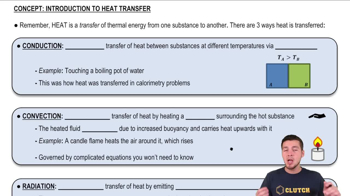
Heat Transfer

Heat transfer is the process by which thermal energy moves from a hotter object to a cooler one. In this scenario, the electric heater transfers heat to the water flowing through the pipe. Understanding the mechanisms of conduction, convection, and radiation is essential for analyzing how effectively heat is transferred to the water.
Video consigliato:
Percorso guidato
05:14
Overview of Heat Transfer

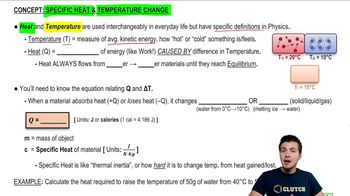
Specific Heat Capacity

Specific heat capacity is the amount of heat required to raise the temperature of a unit mass of a substance by one degree Celsius. For water, this value is approximately 4.18 J/g°C. This concept is crucial for calculating the temperature change of the water as it absorbs heat from the heater, allowing us to determine the outlet temperature.
Video consigliato:
Percorso guidato
06:50
Specific Heat & Temperature Changes

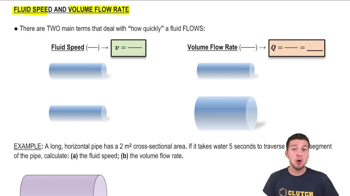
Flow Rate

Flow rate is the volume of fluid that passes through a given surface per unit time, typically measured in liters per minute (L/min). In this problem, the flow rate of 8.0 L/min indicates how quickly water moves through the heater. This rate, combined with the heat transfer from the heater, influences the final temperature of the water exiting the system.
Video consigliato:
Percorso guidato
6:34
Fluid Speed & Volume Flow Rate
Pratica correlata
Domanda del libro di testo

Most stars are main-sequence stars, a group of stars for which size, mass, surface temperature, and radiated power are closely related. The sun, for instance, is a yellow main-sequence star with a surface temperature of 5800 K. For a main-sequence star whose mass M is more than twice that of the sun, the total radiated power, relative to the sun, is approximately P/Psun=1.5(M/Msun)3.5. The star Regulus A is a bluish main-sequence star with mass 3.8Msun and radius 3.1Rsun. What is the surface temperature of Regulus A?

1671
views
Domanda del libro di testo

One cylinder in the diesel engine of a truck has an initial volume of 600 cm3. Air is admitted to the cylinder at 30°C and a pressure of 1.0 atm. The piston rod then does 400 J of work to rapidly compress the air. What are its final temperature and volume?

983
views
Domanda del libro di testo

Liquid helium, with a boiling point of 4.2 K, is used in ultralow-temperature experiments and also for cooling the superconducting magnets used in MRI imaging in medicine. Storing liquid helium so far below room temperature is a challenge because even a small 'heat leak' will boil the helium away. A standard helium dewar, shown in FIGURE P19.67, has an inner stainless-steel cylinder filled with liquid helium surrounded by an outer cylindrical shell filled with liquid nitrogen at –196°C. The space between is a vacuum. The small structural supports have very low thermal conductivity, so you can assume that radiation is the only heat transfer between the helium and its surroundings. Suppose the helium cylinder is 16 cm in diameter and 30 cm tall and that all walls have an emissivity of 0.25. The density of liquid helium is 125 kg/m3 and its heat of vaporization is 2.1×10⁴ J/kg. What is the mass of helium in the filled cylinder?

1825
views
1
rank
Domanda del libro di testo

10 g of aluminum at 200°C and 20 g of copper are dropped into 50 cm3 of ethyl alcohol at 15°C. The temperature quickly comes to 25°C. What was the initial temperature of the copper?

1652
views
Domanda del libro di testo

In Problems 75, 76, and 77 you are given the equation used to solve a problem. For each of these, you are to write a realistic problem for which this is the correct equation.

50J=−n(8.31J/mol K)(350K)ln(13)(200×10−6m3)(13,600kg/m3)50\,\(\text{J}\)=-n(8.31\,\(\text{J/mol K}\))(350\,\(\text{K}\))\(\ln\)\(\left\)(\(\frac\)13\(\right\))(200\(\times\)10^{-6}\,\(\text{m}\)^3)(13,600\,\(\text{kg/m}\)^3)

253
views
Domanda del libro di testo

A lava flow is threatening to engulf a small town. A 400-m-wide, 35-cm-thick tongue of 1200°C lava is advancing at the rate of 1.0 m per minute. The mayor devises a plan to stop the lava in its tracks by flying in large quantities of 20°C water and dousing it. The lava has density 2500 kg/m3, specific heat 1100 J/kg K, melting temperature 800°C, and heat of fusion 4.0×10⁵ J/kg. How many liters of water per minute, at a minimum, will be needed to save the town?

1180
views