What are (a) the heat extracted from the cold reservoir and (b) the coefficient of performance for the refrigerator shown in FIGURE EX21.21?
Ch 21: Heat Engines and Refrigerators
Knight Calc5th EditionPhysics for Scientists and EngineersISBN: 9780137344796Non è quello che usi tu?Cambia libro di testo
Capitolo 21, Problema 21
The heat engine shown in FIGURE P21.62 uses 2.0 mol of a monatomic gas as the working substance. c. What is the engine's thermal efficiency?
Guida verificata passo dopo passo1
Identify the type of cycle the heat engine is operating on (e.g., Carnot, Otto, etc.) and the properties of the working substance, which in this case is a monatomic gas.
Calculate the total heat absorbed (Q_in) by the engine during the heating part of the cycle. This can be done using the formula Q = nC_\(\Delta\) T, where n is the number of moles, C is the molar heat capacity at constant volume for a monatomic gas (3/2 R), and \(\Delta\) T is the change in temperature.
Calculate the total heat expelled (Q_out) by the engine during the cooling part of the cycle, using a similar approach as for Q_in.
Use the formula for thermal efficiency, \(\eta\) = 1 - \(\frac{Q_{out}\)}{Q_{in}}, to find the efficiency of the engine. Substitute the values of Q_out and Q_in obtained from the previous steps.
Interpret the result in terms of efficiency, considering that for real engines, the efficiency is always less than 1 (or 100%).

Risposta video verificata per un problema simile:
Questa soluzione video è stata consigliata dai nostri tutor come utile per risolvere questo problema.
Durata del video:
10mConcetti chiave
Ecco i concetti essenziali che devi comprendere per rispondere correttamente alla domanda.
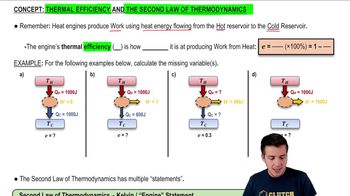
Thermal Efficiency
Thermal efficiency is a measure of how well a heat engine converts heat energy into work. It is defined as the ratio of the work output of the engine to the heat input from the hot reservoir. The efficiency can be expressed as a percentage, and higher efficiency indicates a more effective engine. For ideal engines, the maximum efficiency can be calculated using the Carnot efficiency formula, which depends on the temperatures of the hot and cold reservoirs.
Video consigliato:
Percorso guidato
Thermal Efficiency & The Second Law of Thermodynamics
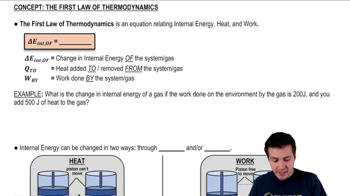
First Law of Thermodynamics
The First Law of Thermodynamics states that energy cannot be created or destroyed, only transformed from one form to another. In the context of a heat engine, this principle implies that the heat absorbed from the hot reservoir minus the work done by the engine equals the heat expelled to the cold reservoir. This law is fundamental in analyzing energy transfers and understanding how engines operate within the constraints of energy conservation.
Video consigliato:
Percorso guidato
The First Law of Thermodynamics
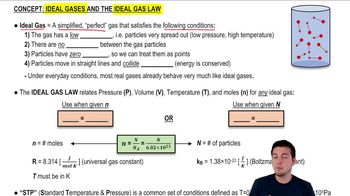
Monatomic Gas Behavior
Monatomic gases consist of single atoms and exhibit specific thermodynamic properties, such as a distinct relationship between pressure, volume, and temperature described by the ideal gas law. For monatomic gases, the specific heat capacities at constant volume and pressure are well-defined, which influences the calculations of work done and heat transfer in thermodynamic processes. Understanding these properties is crucial for determining the performance of the heat engine using such gases.
Video consigliato:
Percorso guidato
Ideal Gases and the Ideal Gas Law
Pratica correlata
Domanda del libro di testo
1572
views
Domanda del libro di testo
Which, if any, of the heat engines in FIGURE EX21.22 violate (a) the first law of thermodynamics or (b) the second law of thermodynamics? Explain.
1606
views
Domanda del libro di testo
At what cold-reservoir temperature (in ℃) would a Carnot engine with a hot-reservoir temperature of 427℃ have an efficiency of 60%?
2141
views
Domanda del libro di testo
An air conditioner removes 5.0 x 10⁵ J/min of heat from a house and exhausts 8.0 x 10⁵ J/min to the hot outdoors. What is the air conditioner's coefficient of performance?
1844
views
Domanda del libro di testo
What are (a) the thermal efficiency and (b) the heat extracted from the hot reservoir for the heat engine shown in FIGURE EX21.16?
1453
views
Domanda del libro di testo
A 15 kW electric generator burns 1.2 gal of diesel fuel per hour. The energy density of diesel fuel is 140 MJ/gal. What is the generator's thermal efficiency?
1607
views