Ch 22: Electric Charges and Forces
Knight Calc - Physics for Scientists and Engineers 5th Edition
Knight Calc5th EditionPhysics for Scientists and EngineersISBN: 9780137344796Non è quello che usi tu?Cambia libro di testo
Capitolo 22, Problema 49b

A +2.0 nC charge is at the origin and a −4.0 nC charge is at x = 1.0 cm. Would the net force be zero for an electron placed at the same position? Explain.

Guida verificata passo dopo passo
1
Step 1: Begin by recalling Coulomb's Law, which describes the force between two charges. The formula is: F=kqQr2, where k is Coulomb's constant, q and Q are the charges, and r is the distance between them.
Step 2: Consider the electron placed at the same position as the −4.0 nC charge (x = 1.0 cm). The electron will experience forces due to both the +2.0 nC charge at the origin and the −4.0 nC charge at x = 1.0 cm.
Step 3: Analyze the direction of the forces. The electron has a negative charge, so it will be attracted to the positive +2.0 nC charge at the origin and repelled by the negative −4.0 nC charge at x = 1.0 cm. These forces act in opposite directions along the x-axis.
Step 4: Calculate the magnitudes of the forces using Coulomb's Law for each interaction. For the force due to the +2.0 nC charge, use the distance of 1.0 cm (converted to meters). For the force due to the −4.0 nC charge, the distance is effectively zero since the electron is at the same position as the −4.0 nC charge.
Step 5: Conclude that the net force cannot be zero because the force due to the −4.0 nC charge is undefined at zero distance (it approaches infinity), and the force due to the +2.0 nC charge is finite. Therefore, the electron would experience a net force and the system would not be in equilibrium.

Risposta video verificata per un problema simile:

Questa soluzione video è stata consigliata dai nostri tutor come utile per risolvere questo problema.
Durata del video:
10m

Concetti chiave

Ecco i concetti essenziali che devi comprendere per rispondere correttamente alla domanda.

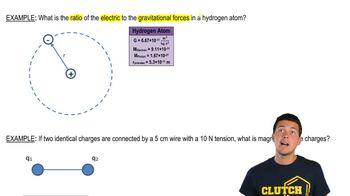
Coulomb's Law

Coulomb's Law describes the electrostatic force between two charged objects. It states that the force is directly proportional to the product of the magnitudes of the charges and inversely proportional to the square of the distance between them. This law is fundamental for calculating the forces acting on charges in an electric field.
Video consigliato:

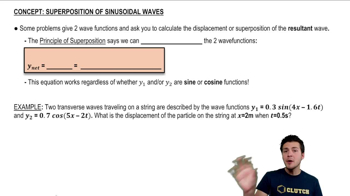
Superposition Principle

The Superposition Principle in electrostatics states that the total force acting on a charge due to multiple other charges is the vector sum of the individual forces exerted by each charge. This principle allows us to analyze complex charge configurations by considering the effect of each charge separately before combining the results.
Video consigliato:
Percorso guidato
03:32
Superposition of Sinusoidal Wave Functions

Electric Field

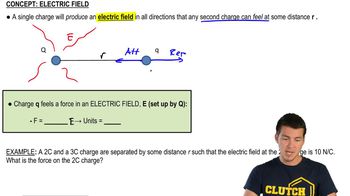
An electric field is a region around a charged object where other charges experience a force. The strength and direction of the electric field depend on the source charge and its position. For an electron placed in an electric field, the force it experiences will depend on the field's direction and magnitude, which can help determine if the net force on it is zero.
Video consigliato:
Percorso guidato
03:16
Intro to Electric Fields
Pratica correlata