Ch 22: Electric Charges and Forces
Knight Calc - Physics for Scientists and Engineers 5th Edition
Knight Calc5th EditionPhysics for Scientists and EngineersISBN: 9780137344796Non è quello che usi tu?Cambia libro di testo
Capitolo 22, Problema 52

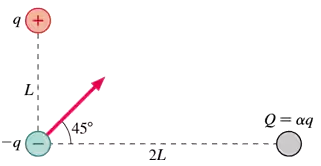
FIGURE P22.52 shows three charges and the net force on charge −q. Charge Q is some multiple α of q. What is α?
Diagram showing three charges: +q, -q, and Q=αq, with net force vector on -q at a 45° angle.

Guida verificata passo dopo passo
1
Step 1: Analyze the problem setup. The figure shows three charges: −q, Q, and another charge. The net force on charge −q is given, and we need to determine the value of α, which represents the ratio of Q to q (i.e., Q = αq). Start by identifying the forces acting on −q due to the other charges.
Step 2: Use Coulomb's law to express the forces between charges. Coulomb's law states that the magnitude of the force between two charges is given by: F=k⁢q⁢Qr2, where k is Coulomb's constant, q and Q are the charges, and r is the distance between them.
Step 3: Break down the forces into components. Since the net force on −q is given, the forces due to the other charges must combine vectorially to produce this net force. Write the force vectors acting on −q due to Q and the other charge, considering their magnitudes and directions.
Step 4: Set up equations for the net force. The net force is the vector sum of the individual forces acting on −q. Use trigonometry or geometry to resolve the forces into components and equate the sum of these components to the given net force.
Step 5: Solve for α. Substitute Q = αq into the equations and solve for α algebraically. This will involve simplifying the expressions and isolating α to determine its value in terms of the given quantities.

Risposta video verificata per un problema simile:

Questa soluzione video è stata consigliata dai nostri tutor come utile per risolvere questo problema.

Concetti chiave

Ecco i concetti essenziali che devi comprendere per rispondere correttamente alla domanda.

Coulomb's Law

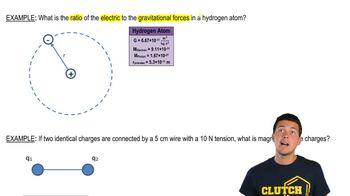
Coulomb's Law describes the electrostatic force between two charged objects. It states that the force is directly proportional to the product of the magnitudes of the charges and inversely proportional to the square of the distance between them. This fundamental principle is essential for calculating the forces acting on charges in a system.
Video consigliato:

Superposition Principle

The Superposition Principle in electrostatics states that the total force acting on a charge due to multiple other charges is the vector sum of the individual forces exerted by each charge. This principle allows us to analyze complex charge configurations by breaking them down into simpler interactions, making it crucial for solving problems involving multiple charges.
Video consigliato:
Percorso guidato
03:32
Superposition of Sinusoidal Wave Functions

Net Force

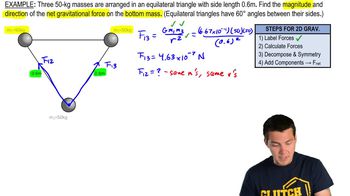
The net force on a charge is the vector sum of all the forces acting on it. In the context of electrostatics, this includes forces from other charges in the vicinity. Understanding how to calculate the net force is vital for determining the conditions under which a charge will remain in equilibrium or move, which is central to solving the given problem.
Video consigliato:
Percorso guidato
06:28
Finding Net Forces in 2D Gravitation
Pratica correlata
Domanda del libro di testo

In a simple model of the hydrogen atom, the electron moves in a circular orbit of radius 0.053 nm around a stationary proton. How many revolutions per second does the electron make?

2131
views
1
comments

Domanda del libro di testo

Two equal point charges 2.5 cm apart, both initially neutral, are being charged at the rate of 5.0 nC/s. At what rate (N/s) is the force between them increasing 1.0 s after charging begins?

279
views
Domanda del libro di testo

What is the force F on the 1.0 nC charge at the bottom in FIGURE P22.47? Give your answer in component form.

4732
views
5
rank
Domanda del libro di testo

You have two small, 2.0 g balls that have been given equal but opposite charges, but you don't know the magnitude of the charge. To find out, you place the balls distance apart on a slippery horizontal surface, release them, and use a motion detector to measure the initial acceleration of one of the balls toward the other. After repeating this for several different separation distances, your data are shown below. Use an appropriate graph of the data to determine the magnitude of the charge.

1609
views
Domanda del libro di testo

A +2.0 nC charge is at the origin and a −4.0 nC charge is at x = 1.0 cm. Would the net force be zero for an electron placed at the same position? Explain.

2288
views
Domanda del libro di testo

What is the force F on the 8.0 nC charge in FIGURE P22.44? Give your answer as a magnitude and an angle measured cw or ccw (specify which) from the +x-axis.

2719
views