
A small 1.0 g block charged to 75 nC is placed on a 30° inclined plane. The coefficients of static and kinetic friction are 0.20 and 0.10, respectively. What minimum strength horizontal electric field is needed to keep the block from sliding down the plane?
Ch 22: Electric Charges and Forces
Knight Calc5th EditionPhysics for Scientists and EngineersISBN: 9780137344796Non è quello che usi tu?Cambia libro di testo
Capitolo 22, Problema 80c
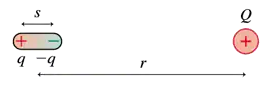
In Section 22.3 we claimed that a charged object exerts a net attractive force on an electric dipole. Let's investigate this. FIGURE CP22.80 shows a permanent electric dipole consisting of charges +q and −q separated by the fixed distance s. Charge +Q is distance r from the center of the dipole. We'll assume, as is usually the case in practice, that s≪r. Use the binomial approximation if x≪1 to show that your expression from part a can be written .

Guida verificata passo dopo passo1
Step 1: Begin by analyzing the forces exerted by the charge +Q on the dipole. The dipole consists of two charges, +q and -q, separated by a fixed distance s. The force on +q is attractive, while the force on -q is repulsive. These forces are not equal in magnitude due to the difference in distances from +Q.
Step 2: Write the expressions for the forces on +q and -q due to +Q using Coulomb's law. The force on +q is given by F_{+q} = K(Qq)/(r-s/2)^2, and the force on -q is given by F_{-q} = K(Qq)/(r+s/2)^2, where K is Coulomb's constant.
Step 3: Calculate the net force on the dipole by subtracting the force on -q from the force on +q. This gives F_{net} = F_{+q} - F_{-q} = K(Qq)/(r-s/2)^2 - K(Qq)/(r+s/2)^2.
Step 4: Apply the binomial approximation (1+x)^{-n} ≈ 1 - nx for x ≪ 1 to simplify the denominators. For (r-s/2)^2 and (r+s/2)^2, expand the terms using the approximation, assuming s ≪ r. This leads to simplified expressions for the forces.
Step 5: Combine the simplified expressions to find the net force. After applying the binomial approximation and simplifying, the net force on the dipole is found to be F_{net} = 2KqQs/r^3, which shows the dependence on the cube of the distance r and the separation s.

Risposta video verificata per un problema simile:
Questa soluzione video è stata consigliata dai nostri tutor come utile per risolvere questo problema.
Concetti chiave
Ecco i concetti essenziali che devi comprendere per rispondere correttamente alla domanda.
Electric Dipole
An electric dipole consists of two equal and opposite charges, +q and -q, separated by a distance s. The dipole moment, a vector quantity, is defined as the product of the charge and the separation distance, pointing from the negative to the positive charge. Electric dipoles create an electric field in their vicinity, which influences other charges, such as a charge +Q placed at a distance r from the dipole.
Video consigliato:
Percorso guidato
Intro To Dipole Moment
Net Force on a Dipole
When a charged object, like +Q, is placed near an electric dipole, it experiences a net force due to the interaction between the dipole's electric field and the charge. The force is attractive if the dipole is oriented such that its positive end faces the positive charge. The net force can be derived using Coulomb's law and depends on the distance r from the dipole and the separation s of the charges within the dipole.
Video consigliato:
Percorso guidato
Intro To Dipole Moment
Binomial Approximation
The binomial approximation is a mathematical simplification used when dealing with expressions of the form (1 + x)^n, particularly when x is much smaller than 1. It allows us to approximate (1 + x)^n as 1 + nx for small values of x. In the context of electric dipoles, this approximation helps simplify calculations involving the forces acting on the dipole when the distance r is much larger than the separation s, making it easier to derive expressions for the net force.
Video consigliato:
Percorso guidato
Index of Refraction
Pratica correlata
Domanda del libro di testo
2776
views
1
rank
Domanda del libro di testo
Space explorers discover an 8.7×10¹⁷ kg asteroid that happens to have a positive charge of 4400 C. They would like to place their 3.3×10⁵ kg spaceship in orbit around the asteroid. Interestingly, the solar wind has given their spaceship a charge of −1.2C. What speed must their spaceship have to achieve a 7500-km-diameter circular orbit?
1839
views
Domanda del libro di testo
A 5.0 g ball charged to 1.5 μC is tied to a 25-cm-long string. It swings at 250 rpm in a horizontal circle around a stationary ball charged to −2.5 μC. What is the tension in the string?
2035
views
