Ch 23: The Electric Field
Knight Calc - Physics for Scientists and Engineers 5th Edition
Knight Calc5th EditionPhysics for Scientists and EngineersISBN: 9780137344796Non è quello che usi tu?Cambia libro di testo
Capitolo 23, Problema 15a

Two 10-cm-diameter charged rings face each other, 20 cm apart. The left ring is charged to −20 nC and the right ring is charged to +20 nC. What is the electric field Ē, both magnitude and direction, at the midpoint between the two rings?

Guida verificata passo dopo passo
1
Determine the position of the midpoint between the two rings. Since the rings are 20 cm apart, the midpoint is located 10 cm from each ring along the axis connecting their centers.
Recall the formula for the electric field along the axis of a charged ring: E = kQz(R2 + z2)3, where k is Coulomb's constant, Q is the charge on the ring, R is the radius of the ring, and z is the distance from the center of the ring to the point where the field is being calculated.
Substitute the given values into the formula for each ring. For the left ring, Q = -20nC, R = 5cm, and z = 10cm. For the right ring, Q = +20nC, R = 5cm, and z = 10cm. Note that the electric field due to each ring will point in opposite directions because the charges are opposite.
Calculate the magnitude of the electric field produced by each ring at the midpoint using the formula. Since the midpoint is equidistant from both rings and the charges are equal in magnitude but opposite in sign, the magnitudes of the electric fields will be the same, but their directions will differ.
Combine the electric fields from both rings. Because the fields point in opposite directions, their magnitudes will add. Determine the net electric field at the midpoint, and specify its direction (toward the positively charged ring).

Risposta video verificata per un problema simile:

Questa soluzione video è stata consigliata dai nostri tutor come utile per risolvere questo problema.

Concetti chiave

Ecco i concetti essenziali che devi comprendere per rispondere correttamente alla domanda.

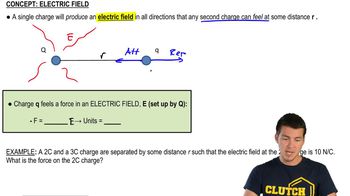
Electric Field

The electric field (E) is a vector field that represents the force per unit charge exerted on a positive test charge placed in the field. It is defined as E = F/q, where F is the force experienced by the charge and q is the magnitude of the charge. The direction of the electric field is away from positive charges and towards negative charges.
Video consigliato:
Percorso guidato
03:16
Intro to Electric Fields

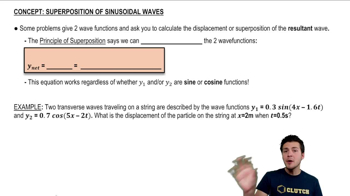
Superposition Principle

The superposition principle states that the total electric field created by multiple charges is the vector sum of the electric fields produced by each charge individually. This principle allows us to calculate the net electric field at a point by considering the contributions from each charge separately, taking into account their magnitudes and directions.
Video consigliato:
Percorso guidato
03:32
Superposition of Sinusoidal Wave Functions

Distance and Charge Relationship

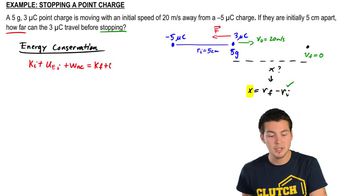
The strength of the electric field produced by a point charge decreases with the square of the distance from the charge, as described by Coulomb's law. For a charged ring, the electric field at a point along its axis can be calculated using the charge and the distance from the ring, which is crucial for determining the electric field at the midpoint between the two rings in this scenario.
Video consigliato:
Percorso guidato
07:12
Distance to Stop a Point Charge
Pratica correlata
Domanda del libro di testo

Two 10-cm-diameter charged rings face each other, 20 cm apart. The left ring is charged to −20 nC and the right ring is charged to +20 nC. What is the force on a proton at the midpoint?

301
views

Domanda del libro di testo

Two 10-cm-diameter charged disks face each other, 20 cm apart. The left disk is charged to −50 nC and the right disk is charged to +50 nC. a. What is the electric field Ē, both magnitude and direction, at the midpoint between the two disks?

1491
views
Domanda del libro di testo

CALC A 12-cm-long thin rod has the nonuniform charge density λ(x)=(2.0nC/cm)e−∣x∣/(6.0cm)\(\lambda\)(x)=(2.0\,\(\text{nC/cm}\))e^{-|x|/(6.0\,\(\text{cm}\))}, where x is measured from the center of the rod. What is the total charge on the rod? Hint: This exercise requires an integration. Think about how to handle the absolute value sign.

2137
views
1
rank
Domanda del libro di testo

You’ve hung two very large sheets of plastic facing each other with distance d between them, as shown in FIGURE EX23.19. By rubbing them with wool and silk, you’ve managed to give one sheet a uniform surface charge density η1=−η0η_1=−η_0 and the other a uniform surface charge density η2=+3η0η_2=+3η_0. What are the electric field vectors at points 1, 2, and 3?

1431
views
Domanda del libro di testo

A small glass bead charged to +6.0 nC is in the plane that bisects a thin, uniformly charged, 10-cm-long glass rod and is 4.0 cm from the rod's center. The bead is repelled from the rod with a force of 840 μN. What is the total charge on the rod?

2497
views
Domanda del libro di testo

Two 10-cm-long thin glass rods uniformly charged to +10 nC are placed side by side, 4.0 cm apart. What are the electric field strengths E1 to E3 at distances 1.0 cm, 2.0 cm, and 3.0 cm to the right of the rod on the left along the line connecting the midpoints of the two rods?

194
views