Ch 24: Gauss' Law
Knight Calc - Physics for Scientists and Engineers 5th Edition
Knight Calc5th EditionPhysics for Scientists and EngineersISBN: 9780137344796Non è quello che usi tu?Cambia libro di testo
Capitolo 24, Problema 21

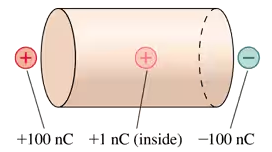
What is the net electric flux through the cylinder of FIGURE EX24.21?
Illustration of a cylinder with charge labels: +100 nC, +1 nC inside, and -100 nC on the side.

Guida verificata passo dopo passo
1
Identify the relevant law: The net electric flux through a closed surface is given by Gauss's Law, which states: Φ = q ⁡ ( enclosed ) ε , where q is the total charge enclosed by the surface and ε is the permittivity of free space.
Determine the charge enclosed by the cylinder: Examine the figure (FIGURE EX24.21) to identify the charges inside the cylindrical surface. Sum up all the charges enclosed by the cylinder to find q.
Substitute the value of the enclosed charge into Gauss's Law: Use the formula Φ = q ⁡ ( enclosed ) ε to calculate the net electric flux. Ensure that the charge is in Coulombs and the permittivity of free space is 8.85×10⁻¹² F·m-1.
Account for symmetry: If the cylinder is symmetric and the electric field is uniform, the flux through the curved surface may cancel out, leaving only contributions from the ends of the cylinder. Verify this based on the figure.
Conclude the net flux: After substituting the values and considering symmetry, the net electric flux through the cylinder is determined by the total enclosed charge divided by the permittivity of free space. Ensure all units are consistent throughout the calculation.

Risposta video verificata per un problema simile:

Questa soluzione video è stata consigliata dai nostri tutor come utile per risolvere questo problema.
Durata del video:
1m

Concetti chiave

Ecco i concetti essenziali che devi comprendere per rispondere correttamente alla domanda.

Gauss's Law

Gauss's Law states that the net electric flux through a closed surface is proportional to the charge enclosed within that surface. Mathematically, it is expressed as Φ_E = Q_enc/ε_0, where Φ_E is the electric flux, Q_enc is the enclosed charge, and ε_0 is the permittivity of free space. This principle is fundamental for calculating electric fields in symmetrical charge distributions.
Video consigliato:

Electric Flux

Electric flux is a measure of the electric field passing through a given area. It is defined as the product of the electric field (E) and the area (A) through which it passes, adjusted for the angle (θ) between the field lines and the normal to the surface: Φ_E = E · A · cos(θ). Understanding electric flux is crucial for applying Gauss's Law effectively.
Video consigliato:

Symmetry in Charge Distributions

Symmetry in charge distributions simplifies the calculation of electric fields and flux. For example, in cylindrical or spherical geometries, the electric field can be assumed uniform over certain surfaces, allowing for straightforward application of Gauss's Law. Recognizing the symmetry helps in determining the enclosed charge and thus the net electric flux through the surface.
Video consigliato:
Percorso guidato
12:39
Solving Symmetric Launch Problems
Pratica correlata
Domanda del libro di testo

Find the electric fluxes ΦA to ΦE through surfaces A to E in FIGURE P24.29.

2189
views

Domanda del libro di testo

A 2.0 cm × 3.0 cm rectangle lies in the xzxz-plane with unit vector n^\(\hat{n}\) pointing in the +y-direction. What is the electric flux through the rectangle if the electric field is E→=(4000i^−2000k^)\(\overrightarrow{E}\)=(4000\(\hat{i}\)-2000\(\hat{k}\)) N/C?

2287
views
Domanda del libro di testo

A 12 cm × 12 cm rectangle lies in the first quadrant of the xy-plane with one corner at the origin. Unit vector n^\(\hat{n}\) points in the +𝒵-direction. What is the electric flux through the rectangle if the electric field is E=(2000m−1)xk^E=(2000m^{-1})x\(\hat{k}\) N/C? Hint: Divide the rectangle into narrow strips of width.

2498
views
1
comments
Domanda del libro di testo

FIGURE EX24.18 shows three charges. Draw these charges on your paper four times. Then draw two-dimensional cross sections of three-dimensional closed surfaces through which the electric flux is (a) 2q/ϵ02q / ϵ_0, (b) q/ϵ0q / ϵ_0, (c) 0, and (d) 5q/ϵ05q / ϵ_0.

1544
views
Domanda del libro di testo

A thin, horizontal, 10-cm-diameter copper plate is charged to 3.5 nC. If the charge is uniformly distributed on the surface, what are the strength and direction of the electric field 0.1 mm above the center of the top surface of the plate?

2063
views
Domanda del libro di testo

A spark occurs at the tip of a metal needle if the electric field strength exceeds 3.0×1063.0\(\times\)10^6 N/C, the field strength at which air breaks down. What is the minimum surface charge density for producing a spark?

1472
views