Ch 24: Gauss' Law
Knight Calc - Physics for Scientists and Engineers 5th Edition
Knight Calc5th EditionPhysics for Scientists and EngineersISBN: 9780137344796Non è quello che usi tu?Cambia libro di testo
Capitolo 24, Problema 26

A spark occurs at the tip of a metal needle if the electric field strength exceeds 3.0×1063.0\(\times\)10^6 N/C, the field strength at which air breaks down. What is the minimum surface charge density for producing a spark?

Guida verificata passo dopo passo
1
Understand the relationship between electric field strength and surface charge density. The electric field near the surface of a conductor is related to the surface charge density (σ) by the formula: E=σ/ε₀, where ε₀ is the permittivity of free space.
Identify the given values in the problem. The electric field strength at which air breaks down is 3.0 × 10⁶ N/C, and the permittivity of free space is a constant: ε₀=8.85×10⁻12 C²/N·m².
Rearrange the formula to solve for surface charge density (σ). Using E=σ/ε₀, multiply both sides by ε₀ to isolate σ: σ=E·ε₀.
Substitute the known values into the formula. Replace E with 3.0 × 10⁶ N/C and ε₀ with 8.85 × 10⁻¹² C²/N·m².
Perform the multiplication to find the minimum surface charge density (σ). The result will be in units of C/m², which represents the surface charge density required to produce a spark.

Risposta video verificata per un problema simile:

Questa soluzione video è stata consigliata dai nostri tutor come utile per risolvere questo problema.

Concetti chiave

Ecco i concetti essenziali che devi comprendere per rispondere correttamente alla domanda.

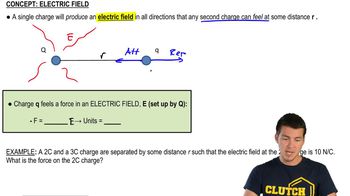
Electric Field Strength

Electric field strength is a measure of the force per unit charge experienced by a charged particle in an electric field. It is expressed in newtons per coulomb (N/C) and indicates how strong the electric field is at a given point. In this context, the electric field strength of 3.0 x 10⁶ N/C is the threshold at which air becomes ionized, allowing a spark to occur.
Video consigliato:
Percorso guidato
03:16
Intro to Electric Fields

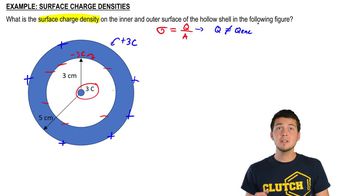
Surface Charge Density

Surface charge density refers to the amount of electric charge per unit area on a surface, typically measured in coulombs per square meter (C/m²). It is crucial for determining how much charge is needed on the needle's surface to create an electric field strong enough to exceed the breakdown threshold of air, leading to a spark.
Video consigliato:
Percorso guidato
04:03
Surface Charge Density

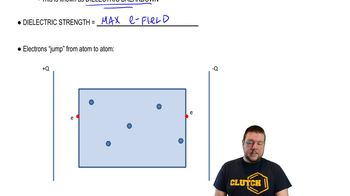
Breakdown Voltage

Breakdown voltage is the minimum voltage that causes a portion of an insulator to become electrically conductive. In the case of air, when the electric field strength exceeds 3.0 x 10⁶ N/C, the air molecules become ionized, allowing current to flow and resulting in a spark. Understanding this concept is essential for calculating the necessary surface charge density to achieve this electric field strength.
Video consigliato:
Percorso guidato
04:32
Dielectric Breakdown