Ch 25: The Electric Potential
Knight Calc - Physics for Scientists and Engineers 5th Edition
Knight Calc5th EditionPhysics for Scientists and EngineersISBN: 9780137344796Non è quello che usi tu?Cambia libro di testo
Capitolo 25, Problema 18

A 250 pg dust particle has charge −250e. Its speed is 2.0 m/s at point 1, where the electric potential is V₁=2000 V. What speed will it have at point 2, where the potential is V₂=−5000 V? Ignore air resistance and gravity.

Guida verificata passo dopo passo
1
Step 1: Recognize that the problem involves the conservation of energy. The total energy of the particle (kinetic energy + electric potential energy) at point 1 must equal the total energy at point 2, as no external forces like air resistance or gravity are acting.
Step 2: Write the expression for the total energy at each point. At point 1, the total energy is the sum of kinetic energy and electric potential energy: \( E_1 = \frac{1}{2}mv_1^2 + qV_1 \). At point 2, the total energy is \( E_2 = \frac{1}{2}mv_2^2 + qV_2 \).
Step 3: Set the total energy at point 1 equal to the total energy at point 2, as energy is conserved: \( \frac{1}{2}mv_1^2 + qV_1 = \frac{1}{2}mv_2^2 + qV_2 \).
Step 4: Rearrange the equation to solve for \( v_2 \), the speed at point 2: \( v_2 = \sqrt{v_1^2 + \frac{2q(V_1 - V_2)}{m}} \).
Step 5: Substitute the given values into the equation. Use \( q = -250e \) (where \( e = 1.6 \times 10^{-19} \ \text{C} \)), \( m = 250 \ \text{pg} = 250 \times 10^{-12} \ \text{kg} \), \( v_1 = 2.0 \ \text{m/s} \), \( V_1 = 2000 \ \text{V} \), and \( V_2 = -5000 \ \text{V} \). Simplify the expression to find \( v_2 \).

Risposta video verificata per un problema simile:

Questa soluzione video è stata consigliata dai nostri tutor come utile per risolvere questo problema.

Concetti chiave

Ecco i concetti essenziali che devi comprendere per rispondere correttamente alla domanda.

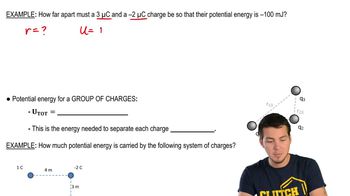
Electric Potential Energy

Electric potential energy is the energy a charged particle possesses due to its position in an electric field. It is defined as the work done to move a charge from a reference point to a specific point in the field. The change in electric potential energy can be calculated using the formula ΔU = qΔV, where q is the charge and ΔV is the change in electric potential.
Video consigliato:
Percorso guidato
07:51
Electric Potential Energy

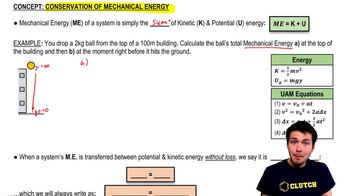
Conservation of Energy

The principle of conservation of energy states that the total energy in a closed system remains constant. In the context of electric fields, the kinetic energy of a charged particle can convert to electric potential energy and vice versa. This means that the sum of kinetic energy and potential energy at one point must equal the sum at another point, allowing us to relate speeds and potentials.
Video consigliato:
Percorso guidato
06:24
Conservation Of Mechanical Energy

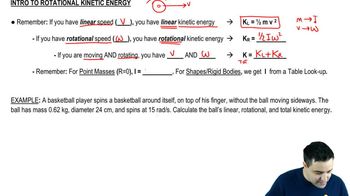
Kinetic Energy

Kinetic energy is the energy an object possesses due to its motion, calculated using the formula KE = 1/2 mv², where m is the mass and v is the velocity of the object. In this scenario, as the dust particle moves through different electric potentials, its kinetic energy will change in response to the changes in electric potential energy, affecting its speed.
Video consigliato:
Percorso guidato
06:07
Intro to Rotational Kinetic Energy
Pratica correlata