
Ch 25: The Electric Potential
Knight Calc - Physics for Scientists and Engineers 5th Edition
Knight Calc5th EditionPhysics for Scientists and EngineersISBN: 9780137344796Non è quello che usi tu?Cambia libro di testo
Capitolo 25, Problema 20b

A student wants to make a very small particle accelerator using a 9.0 V battery. What speed will an electron have after being accelerated from rest through the 9.0 V potential difference?

Guida verificata passo dopo passo
1
Understand the relationship between the potential difference and the kinetic energy gained by the electron. The work done on the electron by the electric field is equal to the change in its kinetic energy. This can be expressed as: qV = \(\frac{1}{2}\)mv^2, where q is the charge of the electron, V is the potential difference, m is the mass of the electron, and v is the final speed of the electron.
Rearrange the equation to solve for the speed v: v = \(\sqrt{\frac{2qV}{m}\)}.
Substitute the known values into the equation. The charge of the electron is q = 1.6 \(\times\) 10^{-19} \(\text{ C}\), the potential difference is V = 9.0 \(\text{ V}\), and the mass of the electron is m = 9.11 \(\times\) 10^{-31} \(\text{ kg}\).
Perform the calculation inside the square root: calculate 2qV and divide it by m.
Take the square root of the result to find the final speed v of the electron.

Risposta video verificata per un problema simile:

Questa soluzione video è stata consigliata dai nostri tutor come utile per risolvere questo problema.
Durata del video:
4m

Concetti chiave

Ecco i concetti essenziali che devi comprendere per rispondere correttamente alla domanda.

Electric Potential Energy

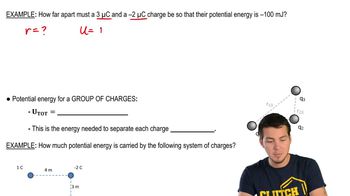
Electric potential energy is the energy a charged particle possesses due to its position in an electric field. When a charged particle, like an electron, moves through a potential difference, it gains energy equal to the product of its charge and the voltage. This energy is converted into kinetic energy as the particle accelerates.
Video consigliato:
Percorso guidato
07:51
Electric Potential Energy

Kinetic Energy

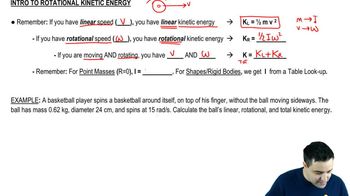
Kinetic energy is the energy of an object due to its motion, defined mathematically as KE = 1/2 mv², where m is mass and v is velocity. In the context of the question, the kinetic energy gained by the electron after being accelerated through a potential difference can be equated to the electric potential energy it acquired, allowing us to calculate its final speed.
Video consigliato:
Percorso guidato
06:07
Intro to Rotational Kinetic Energy

Conservation of Energy

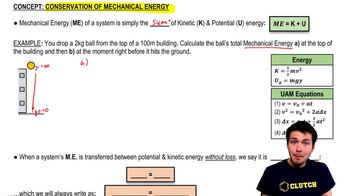
The principle of conservation of energy states that energy cannot be created or destroyed, only transformed from one form to another. In this scenario, the electric potential energy gained by the electron as it moves through the voltage is converted entirely into kinetic energy, enabling us to relate the voltage to the speed of the electron.
Video consigliato:
Percorso guidato
06:24
Conservation Of Mechanical Energy
Pratica correlata
Domanda del libro di testo

A 250 pg dust particle has charge −250e. Its speed is 2.0 m/s at point 1, where the electric potential is V₁=2000 V. What speed will it have at point 2, where the potential is V₂=−5000 V? Ignore air resistance and gravity.

211
views
Domanda del libro di testo

An electron with an initial speed of 500,000 m/s is brought to rest by an electric field. Did the electron move into a region of higher potential or lower potential?

194
views
Domanda del libro di testo

A 3.0-cm-diameter parallel-plate capacitor has a 2.0 mm spacing. The electric field strength inside the capacitor is 1.0×10⁵ V/m. How much charge is on each plate?

1789
views
Domanda del libro di testo

In proton-beam therapy, a high-energy beam of protons is fired at a tumor. As the protons stop in the tumor, their kinetic energy breaks apart the tumor's DNA, thus killing the tumor cells. For one patient, it is desired to deposit 0.10 J of proton energy in the tumor. To create the proton beam, protons are accelerated from rest through a 10,000 kV potential difference. What is the total charge of the protons that must be fired at the tumor?

208
views
Domanda del libro di testo

Two 2.00 cm×2.00 cm plates that form a parallel-plate capacitor are charged to ±0.708 nC. What are the electric field strength inside and the potential difference across the capacitor if the spacing between the plates is 1.00 mm?

2146
views
Domanda del libro di testo

A 3.0-cm-diameter parallel-plate capacitor has a 2.0 mm spacing. The electric field strength inside the capacitor is 1.0×10⁵ V/m. What is the potential difference across the capacitor?

2487
views