Ch 25: The Electric Potential
Knight Calc - Physics for Scientists and Engineers 5th Edition
Knight Calc5th EditionPhysics for Scientists and EngineersISBN: 9780137344796Non è quello che usi tu?Cambia libro di testo
Capitolo 25, Problema 39

A +3.0 nC charge is at x=0 cm and a −1.0 nC charge is at x=4 cm. At what point or points on the x-axis is the electric potential zero?

Guida verificata passo dopo passo
1
Understand the problem: The electric potential at a point due to a charge is given by the formula \( V = \frac{kq}{r} \), where \( k \) is Coulomb's constant, \( q \) is the charge, and \( r \) is the distance from the charge to the point. The goal is to find the point(s) on the x-axis where the total electric potential from both charges is zero.
Set up the equation for the total electric potential: The total potential at a point \( x \) on the x-axis is the sum of the potentials due to the two charges. Let the distance from the +3.0 nC charge to the point be \( r_1 \) and the distance from the −1.0 nC charge to the point be \( r_2 \). The equation becomes \( \frac{k(3.0 \times 10^{-9})}{r_1} + \frac{k(-1.0 \times 10^{-9})}{r_2} = 0 \).
Express the distances \( r_1 \) and \( r_2 \) in terms of \( x \): Since the +3.0 nC charge is at \( x = 0 \) cm and the −1.0 nC charge is at \( x = 4 \) cm, \( r_1 = |x| \) and \( r_2 = |x - 4| \). Substitute these into the equation: \( \frac{k(3.0 \times 10^{-9})}{|x|} + \frac{k(-1.0 \times 10^{-9})}{|x - 4|} = 0 \).
Simplify the equation: Cancel out \( k \) (since it is a common factor) and rewrite the equation as \( \frac{3.0 \times 10^{-9}}{|x|} = \frac{1.0 \times 10^{-9}}{|x - 4|} \). Simplify further to \( \frac{3}{|x|} = \frac{1}{|x - 4|} \).
Solve for \( x \): Cross-multiply to get \( 3|x - 4| = |x| \). This equation can be solved by considering the different cases for \( x \) (e.g., \( x < 0 \), \( 0 < x < 4 \), and \( x > 4 \)) to find the point(s) where the electric potential is zero. Analyze each case to determine the valid solution(s).

Risposta video verificata per un problema simile:

Questa soluzione video è stata consigliata dai nostri tutor come utile per risolvere questo problema.

Concetti chiave

Ecco i concetti essenziali che devi comprendere per rispondere correttamente alla domanda.

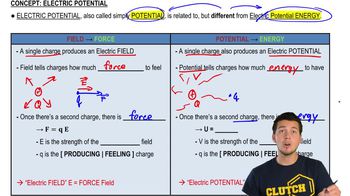
Electric Potential

Electric potential is the amount of electric potential energy per unit charge at a point in an electric field. It is a scalar quantity measured in volts (V) and indicates the work done to move a unit positive charge from a reference point to a specific point in the field without any acceleration.
Video consigliato:
Percorso guidato
07:33
Electric Potential

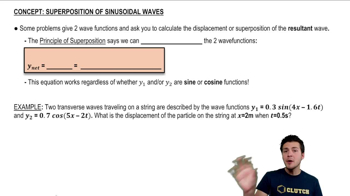
Superposition Principle

The superposition principle states that the total electric potential at a point due to multiple charges is the algebraic sum of the potentials due to each charge individually. This principle allows us to analyze complex charge configurations by considering the contributions from each charge separately.
Video consigliato:
Percorso guidato
03:32
Superposition of Sinusoidal Wave Functions

Distance and Charge Relationship

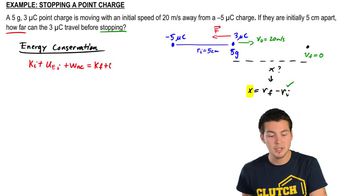
The electric potential created by a point charge decreases with distance from the charge. Specifically, the potential (V) due to a point charge (Q) at a distance (r) is given by V = kQ/r, where k is Coulomb's constant. This relationship is crucial for determining where the total potential is zero, as it helps identify the influence of each charge at various points along the x-axis.
Video consigliato:
Percorso guidato
07:12
Distance to Stop a Point Charge