Ch 25: The Electric Potential
Knight Calc - Physics for Scientists and Engineers 5th Edition
Knight Calc5th EditionPhysics for Scientists and EngineersISBN: 9780137344796Non è quello che usi tu?Cambia libro di testo
Capitolo 25, Problema 40b

Two small metal cubes with masses 2.0 g and 4.0 g are tied together by a 5.0-cm-long massless string and are at rest on a frictionless surface. Each is charged to +2.0 μC. What is the tension in the string?

Guida verificata passo dopo passo
1
Convert the given masses of the cubes from grams to kilograms. Since 1 g = 0.001 kg, the masses are m₁ = 0.002 kg and m₂ = 0.004 kg.
Calculate the electrostatic force between the two charged cubes using Coulomb's law: F = (k * |q₁ * q₂|) / r², where k = 8.99 × 10⁹ N·m²/C² (Coulomb's constant), q₁ = q₂ = 2.0 × 10⁻⁶ C, and r = 0.05 m (the length of the string).
Substitute the values into Coulomb's law formula to find the magnitude of the electrostatic force: F = (8.99 × 10⁹ * (2.0 × 10⁻⁶)²) / (0.05)².
Recognize that the tension in the string must balance the electrostatic force because the system is in equilibrium (the cubes are at rest). Therefore, the tension in the string is equal to the magnitude of the electrostatic force.
State that the tension in the string is numerically equal to the calculated electrostatic force, which can be determined by completing the substitution and performing the arithmetic.

Risposta video verificata per un problema simile:

Questa soluzione video è stata consigliata dai nostri tutor come utile per risolvere questo problema.

Concetti chiave

Ecco i concetti essenziali che devi comprendere per rispondere correttamente alla domanda.

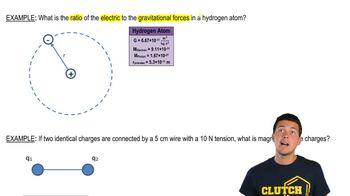
Coulomb's Law

Coulomb's Law describes the electrostatic force between two charged objects. It states that the force is directly proportional to the product of the magnitudes of the charges and inversely proportional to the square of the distance between them. This principle is essential for calculating the force acting on the cubes due to their charges.
Video consigliato:

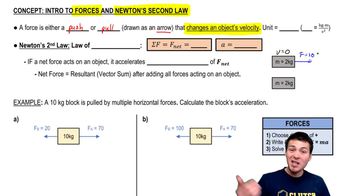
Newton's Second Law

Newton's Second Law states that the acceleration of an object is directly proportional to the net force acting on it and inversely proportional to its mass. This law is crucial for determining the relationship between the forces acting on the cubes and the resulting tension in the string, as it allows us to analyze the motion of the system.
Video consigliato:
Percorso guidato
06:54
Intro to Forces & Newton's Second Law

Tension in a String

Tension is the force transmitted through a string or rope when it is pulled tight by forces acting at either end. In this scenario, the tension in the string connecting the two charged cubes must balance the electrostatic force between them, allowing us to calculate the tension based on the forces involved and the masses of the cubes.
Video consigliato:
Percorso guidato
04:39
Energy & Power of Waves on Strings