
Ch 25: The Electric Potential
Knight Calc - Physics for Scientists and Engineers 5th Edition
Knight Calc5th EditionPhysics for Scientists and EngineersISBN: 9780137344796Non è quello che usi tu?Cambia libro di testo
Capitolo 25, Problema 67

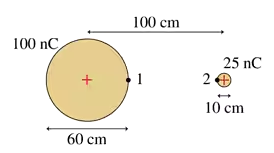
FIGURE P25.67 shows two uniformly charged spheres. What is the potential difference between points 1 and 2? Which point is at the higher potential? Hint: The potential at any point is the superposition of the potentials due to all charges.

Guida verificata passo dopo passo
1
Step 1: Understand the concept of electric potential. The electric potential at a point due to a charge is given by the formula V = (k * Q) / r, where k is Coulomb's constant (8.99 × 10^9 N·m²/C²), Q is the charge, and r is the distance from the charge to the point.
Step 2: Calculate the potential at point 1 due to the 100 nC sphere. Use the formula V = (k * Q) / r, where Q = 100 nC and r is the radius of the sphere (30 cm or 0.3 m).
Step 3: Calculate the potential at point 1 due to the 25 nC sphere. Use the formula V = (k * Q) / r, where Q = 25 nC and r is the distance between point 1 and the center of the 25 nC sphere (100 cm or 1 m).
Step 4: Calculate the potential at point 2 due to the 100 nC sphere. Use the formula V = (k * Q) / r, where Q = 100 nC and r is the distance between point 2 and the center of the 100 nC sphere (100 cm or 1 m).
Step 5: Calculate the potential at point 2 due to the 25 nC sphere. Use the formula V = (k * Q) / r, where Q = 25 nC and r is the radius of the sphere (10 cm or 0.1 m). Add the potentials at each point to find the total potential at points 1 and 2, then subtract to find the potential difference. Compare the values to determine which point is at the higher potential.

Risposta video verificata per un problema simile:

Questa soluzione video è stata consigliata dai nostri tutor come utile per risolvere questo problema.

Concetti chiave

Ecco i concetti essenziali che devi comprendere per rispondere correttamente alla domanda.

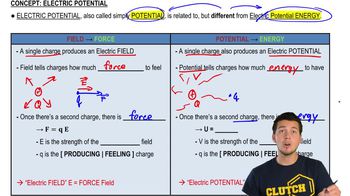
Electric Potential

Electric potential at a point in space is the amount of electric potential energy per unit charge that a positive test charge would have at that point. It is influenced by the presence of electric charges and is measured in volts (V). The potential due to a point charge can be calculated using the formula V = kQ/r, where k is Coulomb's constant, Q is the charge, and r is the distance from the charge.
Video consigliato:
Percorso guidato
07:33
Electric Potential

Superposition Principle

The superposition principle states that the total electric potential at a point due to multiple charges is the algebraic sum of the potentials due to each charge individually. This means that to find the potential at a point, one can calculate the potential from each charge separately and then add them together, taking into account their signs and distances.
Video consigliato:
Percorso guidato
03:32
Superposition of Sinusoidal Wave Functions

Potential Difference

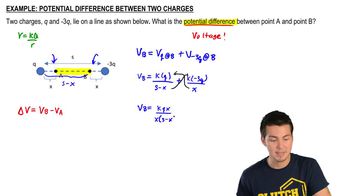
Potential difference, or voltage, between two points is defined as the difference in electric potential between those points. It indicates how much work is needed to move a unit charge from one point to another. In this context, determining which point has a higher potential involves comparing the calculated potentials at points 1 and 2, allowing us to ascertain the direction of electric force on a positive test charge.
Video consigliato:
Percorso guidato
07:04
Potential Difference Between Two Charges
Pratica correlata
Domanda del libro di testo

Two metal objects that are in contact must be at the same potential, an assertion we'll prove in the next chapter. Suppose a metal sphere of radius R is charged to 1000 V and a second metal sphere of radius 2R is charged to 2000 V. The two spheres are brought into contact and then separated. Afterward, what is the potential of each sphere?

229
views
Domanda del libro di testo

Two spherical drops of mercury each have a charge of 0.10 nC and a potential of 300 V at the surface. The two drops merge to form a single drop. What is the potential at the surface of the new drop?

132
views
Domanda del libro di testo

FIGURE P25.72 shows a thin rod with charge Q that has been bent into a semicircle of radius R. Find an expression for the electric potential at the center.

442
views
Domanda del libro di testo

FIGURE P25.70 shows a thin rod of length L and charge Q. Find an expression for the electric potential a distance x away from the center of the rod on the axis of the rod.

307
views
Domanda del libro di testo

The potential 1.0 cm from the surface of a metal sphere is 8000 V. The potential 3.0 cm from the surface is 4000 V. What is the radius of the sphere?

142
views
Domanda del libro di testo

A Van de Graaff generator is a device for generating a large electric potential by building up charge on a hollow metal sphere. A typical classroom-demonstration model has a diameter of 30 cm. What is the electric field strength just outside the surface of the sphere when it is charged to 500,000 V?

1699
views