Ch 25: The Electric Potential
Knight Calc - Physics for Scientists and Engineers 5th Edition
Knight Calc5th EditionPhysics for Scientists and EngineersISBN: 9780137344796Non è quello che usi tu?Cambia libro di testo
Capitolo 25, Problema 68

Two metal objects that are in contact must be at the same potential, an assertion we'll prove in the next chapter. Suppose a metal sphere of radius R is charged to 1000 V and a second metal sphere of radius 2R is charged to 2000 V. The two spheres are brought into contact and then separated. Afterward, what is the potential of each sphere?

Guida verificata passo dopo passo
1
Step 1: Understand the concept of charge redistribution. When two conductors are brought into contact, charge redistributes between them until they reach the same electric potential. This is because charges move to minimize potential differences.
Step 2: Write the formula for the potential of a sphere. The potential of a charged sphere is given by \( V = \frac{Q}{4 \pi \epsilon_0 R} \), where \( Q \) is the charge, \( R \) is the radius, and \( \epsilon_0 \) is the permittivity of free space.
Step 3: Use the principle of charge conservation. The total charge before contact is equal to the total charge after contact. Let \( Q_1 \) and \( Q_2 \) be the initial charges on the spheres, and \( Q_1' \) and \( Q_2' \) be the charges after contact. Then, \( Q_1 + Q_2 = Q_1' + Q_2' \).
Step 4: Set the potentials equal after contact. Since the spheres are in contact, their potentials become equal: \( \frac{Q_1'}{4 \pi \epsilon_0 R} = \frac{Q_2'}{4 \pi \epsilon_0 (2R)} \). Simplify this equation to relate \( Q_1' \) and \( Q_2' \).
Step 5: Solve for the final potential. Use the charge conservation equation and the relationship between \( Q_1' \) and \( Q_2' \) to find the total charge and distribute it between the spheres. Substitute the charges into the potential formula to find the final potential of each sphere.

Risposta video verificata per un problema simile:

Questa soluzione video è stata consigliata dai nostri tutor come utile per risolvere questo problema.

Concetti chiave

Ecco i concetti essenziali che devi comprendere per rispondere correttamente alla domanda.

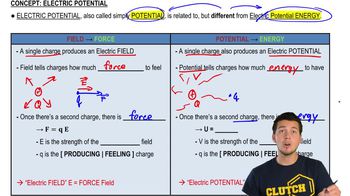
Electric Potential

Electric potential, measured in volts (V), is the amount of electric potential energy per unit charge at a point in an electric field. It indicates how much work would be done to move a charge from a reference point to a specific point within the field. In this scenario, the potentials of the two spheres before contact are crucial for understanding how they will equalize when brought into contact.
Video consigliato:
Percorso guidato
07:33
Electric Potential

Charge Distribution

When two conductive objects come into contact, charge redistributes between them until they reach the same electric potential. The total charge is conserved, meaning the sum of the charges on both spheres before contact equals the sum after they are separated. This principle is essential for determining the final potential of each sphere after they are disconnected.
Video consigliato:
Percorso guidato
04:03
Probability Distribution Graph

Capacitance

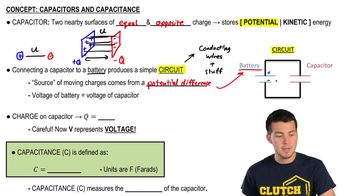
Capacitance is the ability of a system to store charge per unit potential difference and is influenced by the geometry of the conductors. For spheres, capacitance is proportional to their radius, meaning a larger sphere can hold more charge at the same potential. Understanding capacitance helps in calculating how the charges will distribute between the two spheres based on their sizes and initial potentials.
Video consigliato:
Percorso guidato
08:02
Capacitors & Capacitance (Intro)