Two small charged spheres are 5.0 cm apart. One is charged to +25 nC, the other to −15 nC. A proton is released from rest halfway between the spheres. What is the proton's speed after it has moved 1.0 cm?
Ch 25: The Electric Potential
Knight Calc5th EditionPhysics for Scientists and EngineersISBN: 9780137344796Non è quello che usi tu?Cambia libro di testo
Capitolo 25, Problema 29a
In a semiclassical model of the hydrogen atom, the electron orbits the proton at a distance of 0.053 nm. What is the electric potential of the proton at the position of the electron?
Guida verificata passo dopo passo1
Step 1: Recall the formula for electric potential due to a point charge, which is given by \( V = \frac{k \cdot q}{r} \), where \( k \) is Coulomb's constant (\( 8.99 \times 10^9 \, \text{N·m}^2/\text{C}^2 \)), \( q \) is the charge of the proton (\( +1.6 \times 10^{-19} \, \text{C} \)), and \( r \) is the distance from the charge (\( 0.053 \, \text{nm} \) or \( 0.053 \times 10^{-9} \, \text{m} \)).
Step 2: Convert the distance \( r \) from nanometers to meters. Since \( 1 \, \text{nm} = 10^{-9} \, \text{m} \), multiply \( 0.053 \, \text{nm} \) by \( 10^{-9} \) to express \( r \) in meters.
Step 3: Substitute the values for \( k \), \( q \), and \( r \) into the formula \( V = \frac{k \cdot q}{r} \). Ensure all units are consistent (Coulombs for charge, meters for distance).
Step 4: Simplify the expression by performing the division \( \frac{k \cdot q}{r} \). This will yield the electric potential \( V \) in volts (\( \text{V} \)).
Step 5: Interpret the result. The electric potential represents the work done per unit charge to bring a positive test charge from infinity to the position of the electron in the hydrogen atom.

Risposta video verificata per un problema simile:
Questa soluzione video è stata consigliata dai nostri tutor come utile per risolvere questo problema.
Durata del video:
4mConcetti chiave
Ecco i concetti essenziali che devi comprendere per rispondere correttamente alla domanda.
Electric Potential
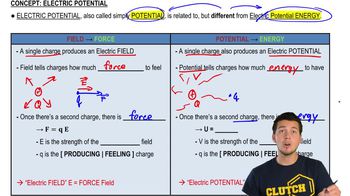
Electric potential, often referred to as voltage, is the amount of electric potential energy per unit charge at a specific point in an electric field. It indicates how much work would be done to move a positive test charge from a reference point to the point in question. In the context of the hydrogen atom, the electric potential due to the proton at the location of the electron can be calculated using the formula V = k * (q / r), where k is Coulomb's constant, q is the charge of the proton, and r is the distance from the proton to the electron.
Video consigliato:
Percorso guidato
Electric Potential
Coulomb's Law
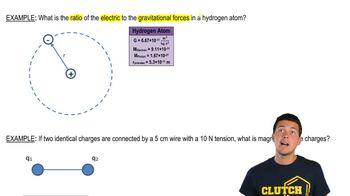
Coulomb's Law describes the force between two charged objects. It states that the force is directly proportional to the product of the magnitudes of the charges and inversely proportional to the square of the distance between them. This law is fundamental in electrostatics and is essential for calculating the electric potential in systems like the hydrogen atom, where the proton and electron interact through their electric charges.
Video consigliato:
Percorso guidato
Coulomb's Law
Hydrogen Atom Model
The semiclassical model of the hydrogen atom combines classical mechanics and quantum mechanics to describe the behavior of the electron in relation to the proton. In this model, the electron is treated as a particle moving in a circular orbit around the proton, influenced by the electrostatic force. Understanding this model is crucial for calculating properties like electric potential, as it provides the framework for analyzing the interactions between the charged particles.
Video consigliato:
Percorso guidato
Charge of Atom
Pratica correlata
Domanda del libro di testo
2118
views
Domanda del libro di testo
What are the potential differences ΔVₐᵦ=Vᵦ−Vₐ and ΔV𝒸ᵦ=Vᵦ−V𝒸?
48
views
Domanda del libro di testo
What is the electric potential at the point indicated with the dot in FIGURE EX25.31?
258
views
Domanda del libro di testo
A 1.0-mm-diameter ball bearing has 2.0×10⁹ excess electrons. What is the ball bearing's potential?
2369
views
Domanda del libro di testo
Two 2.0-cm-diameter disks spaced 2.0 mm apart form a parallel-plate capacitor. The electric field between the disks is 5.0×10⁵ V/m. An electron is launched from the negative plate. It strikes the positive plate at a speed of 2.0×10⁷ m/s. What was the electron's speed as it left the negative plate?
2619
views
Domanda del libro di testo
In a semiclassical model of the hydrogen atom, the electron orbits the proton at a distance of 0.053 nm. What is the electron's potential energy?
1653
views